
The Weekly Takeaway:
- The S&P 500 continued its rally and gained 2.33% this week thanks to continued optimism regarding AI, better than expected jobs data, and reduced fears that the war with Iran would escalate. The index is now up 8.08% for the year;
- The Nasdaq-100 gained 5.50% this week as earnings supported higher prices and as AI names continued to shine. The index is now up 15.78% for the year;
- Crude oil futures fell 7.41% this week despite the war becoming kinetic again. Crude futures ended the week at 94.68;
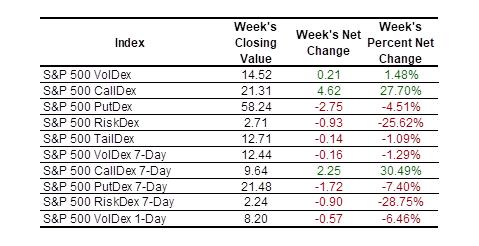
- S&P 500 VolDex (ticker VOLI) rose by 1.48% to close at 14.52. However, it rose by 1.21% on Friday despite the S&P gaining ground that day and the jobs catalyst passing. Last week VOLI rose on Friday despite the S&P gaining ground and we pointed out that “It is very odd for VOLI to gain ground on a Friday when the S&P rallies” yet it did so again this week;
- S&P 500 CallDex rose by 27.70% and closed at the 70th percentile of its 52-week range signaling substantial optimism for the next 30 days. You can learn more about CallDex at Learn More About CallDex;
- S&P 500 PutDex fell by 4.51% this week and TailDex (ticker TDEX) fell by 1.09% signaling that few are worried about downside risks;
- VolDex on the Nasdaq-100 rose by 10.78% mimicking but amplifying the move in VolDex on the S&P 500;
- Nasdaq-100 CallDex rose an impressive 48.17% to close at 41.56. That is a new 52-week high;
- Nasdaq-100 TailDex fell by 18.50% to close at just 10.01 which is the 6th percentile of its 52-week range. You can learn more about TailDex at Learn More About TailDex;
- The yield on Treasury Notes fell 1.4 basis points this week and closed at 4.364%;
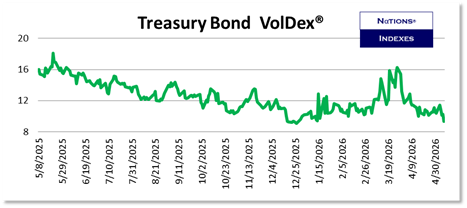
- Volatility in Treasury Bonds retreated this week with VolDex falling 10.26% and closing at 9.32. That is the 3rd percentile of its 52-week range;
- The individual equities we cover were generally higher with only JPM (-3.32%), LLY (-1.54%), PLTR (-4.35%), and WMT (-0.89%) falling. AMD was the big gainer (+26.25%) thanks to better than expected earnings and guidance;
- VolDex on individual stocks was more mixed with several names posting higher VolDex values. You can see the week’s results below;
- The Nations Indexes Optimism Index® rose by 2.74% to close at 88.13. Our Optimism Index is always available in real-time on our home page at NationsIndexes.com;
- You can always learn more about all our indexes at Learn More About Our Indexes.
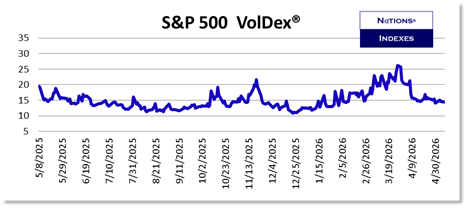
Equity Index Volatility:
The S&P 500 rose 2.33% on the week to close at 7398.93 after making a new all-time high of 7401.50 earlier on Friday. This is the third consecutive week the market has posted a new all-time high on Friday. Last week we pointed out that “This is an expression of confidence in the prospects for technology names” and that was reinforced this week.
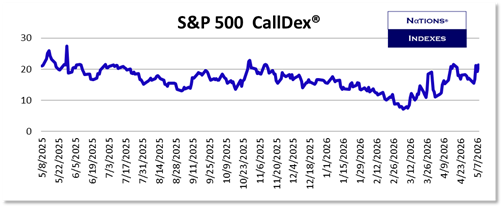
S&P 500 PutDex fell by 4.51% after falling 10.37% last week. This is in sharp contrast to the gain of 27.70% for CallDex. Options are showing a strongly bullish lean as RiskDex lost 25.62% to close at 2.71 which is just the 2nd percentile of its 52-week range.
S&P 500 CallDex has gained 91.98% since April 2nd.
Historical metrics (Average, median, 10th percentile, 25th percentile, 75th percentile, and 90th percentile) for all our indexes are available to subscribers at NationsIndexes.com.
Why It Matters…Historical data for all our indexes is available to subscribers at the Everything! level and they allow option traders to understand the context of the current option pricing environment. You have to understand what normal is in order to do so.
Nasdaq-100 VolDex rose by 10.78% this week and rose by 5.38% on Friday.
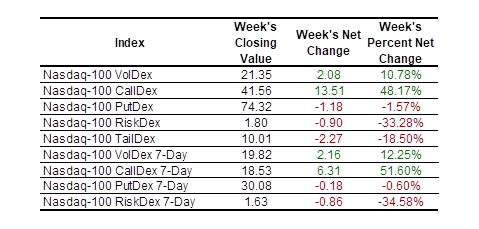
Nasdaq-100 VolDex is at the 46th percentile of its 52-week range in an expression of the expectation for continued volatility, including potentially upside volatility, over the next 30 days.
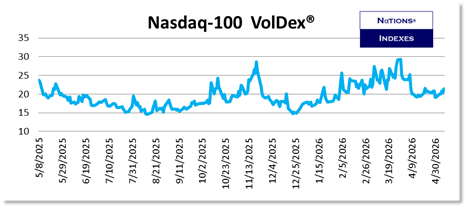
You can learn more about VolDex at Learn More About VolDex.
Nasdaq-100 CallDex rose by 48.17% for the week and closed at the very top of its 52-week range as traders continue to pay up for bullish exposure.
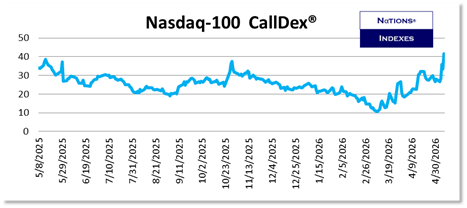
You can learn more about CallDex at Learn More About CallDex.
Why It Matters…Traders have to have the objective data provided by our indexes to trade in a way that doesn’t rely on hunches or guesses.
Nations Investor Optimism Index®:
The Investor Optimism Index® rose by 2.74% to close at 88.13.
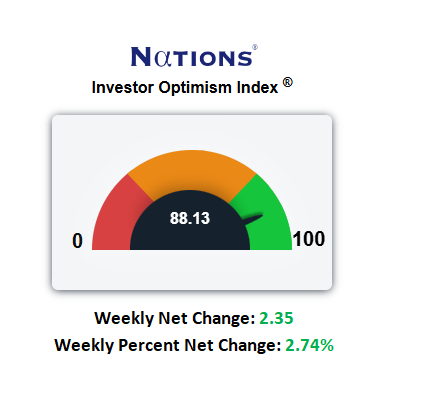
The index takes into account the current levels of S&P 500 VolDex, TailDex, and RiskDex and compares them to their rolling 2-year ranges. It is plotted on a 0 to 100 scale.
Our Optimism Index is now available in real-time on our home page at Nations Optimism Index.
Option Window®:
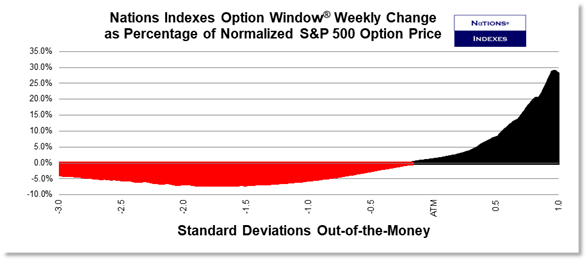
S&P 500 Option Window fills in the blanks between TailDex, PutDex, VolDex, and CallDex and reveals how trade flows were driving option prices. Since Option Window calculates normalized option prices at fixed points of moneyness any changes are driven by option flows rather than movement in the underlying S&P 500.
Option prices were lower in the range that is below at-the-money but at-the-money options (e.g., VolDex) were higher and intense buying interest drove out-of-the-money calls substantially higher.
Term Structure:
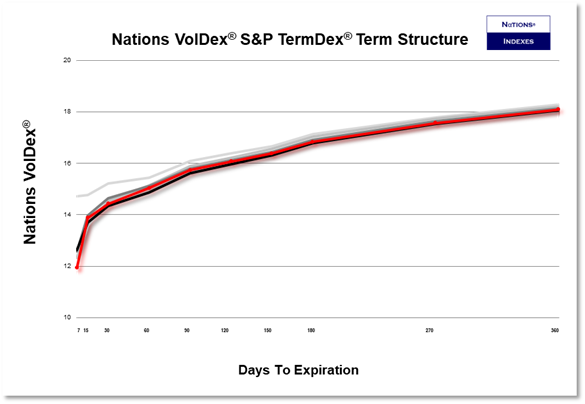
The Nations TermDex® measure of VolDex term structure illustrates S&P 500 VolDex for various tenors. It provides insight into both near-term and longer-term expectations for volatility in the S&P 500.
Term structure at the close on Friday (in red) remains upward-sloping from left to right. This suggests little concern for the S&P 500 over the next 7 days.
1DTE Options:
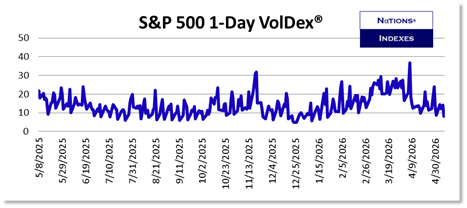
S&P 500 1-Day VolDex fell 6.46% and is once again convincingly below 9.00.
Very short-dated volatility measures which use a variance swap methodology, as 1-day VIX does, inject significant error into the resulting measure because of the way out-of-the-money options trade in the hours before expiration. The VolDex at-the-money methodology is particularly suited for these very short-dated tenors.
Other Asset Volatility:
Treasury Bonds and Notes:
Bond futures rose slightly this week, arresting last week’s decline.
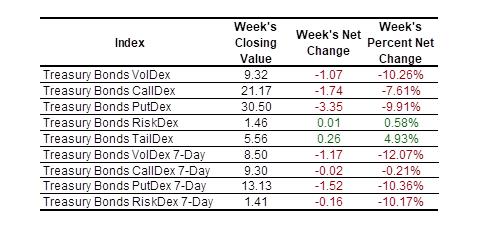
Treasury Bond option prices fell in response with VolDex falling 10.26% and closing at just 9.32 which is the 3rd percentile of its 52-week range. Any directional speculation in Treasury Bonds should be expressed using at-the-money options.
Precious Metals:
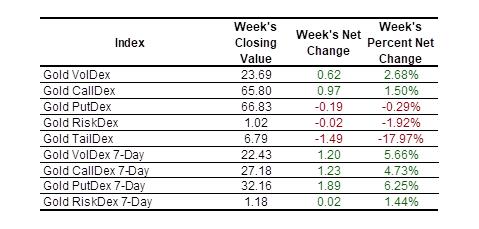
Gold gained 2.18% on the week, reversing last week’s loss. Gold volatility was mixed and the 17.97% decline in TailDex is interesting.
Equities:
We have expanded the list of single names we cover to include not only the most dynamic stocks in the S&P 500 and the stocks with the highest option volume, but also the largest names in the S&P 500.
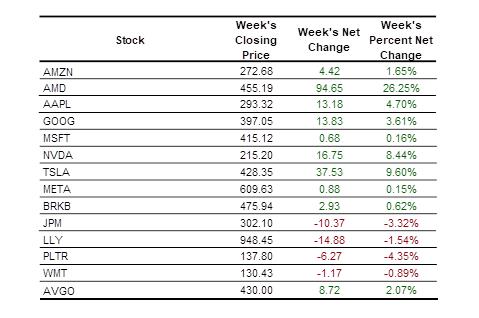
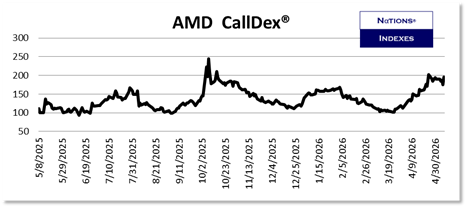
AMD was the big gainer on the week as it posted better than expected earnings and issued positive forward guidance. AMD is up 112.55% YTD.
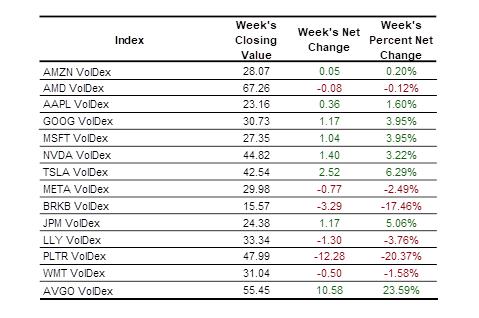
AMD volatility was mixed which means the 18.61% rally on Wednesday and the 11.44% rally on Friday are overwhelming the typical post-earnings volatility crush.
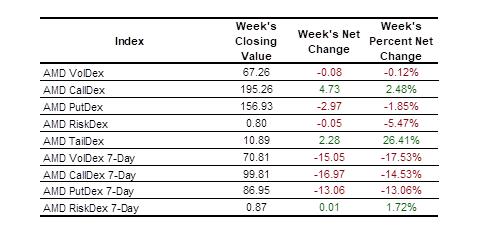
Despite this realized volatility, AMD CallDex is still somewhat reasonably priced albeit from a much higher underlying share value.
You can learn more about CallDex at Learn More About CallDex.
We’ll continue to comment during the week via our X account, @Nations_Indexes.
Scott's Weekly Commentary:
Most investors have missed the fact that the small-cap Russell 2000 is up nearly as much as the Nasdaq-100 this year (+15.28% vs. 15.78%). That’s pretty impressive given so much focus on AI and tech names and so little focus on other names.
Another wildly underreported story is the fact that our federal debt is now larger than our entire economy. This is a glaring strategic weakness. It also means the typical playbook in a financial crisis will be much less effective the next time we need it. Traditionally the proper course was for the federal government to borrow money and then step in and spend that money. It worked in the 1930s and following 2008 but the Keynesian approach makes two assumptions. The first is that when times are good we pay down the borrowing from when times are bad. We’ve omitted this step. The second assumption is that the government can borrow money during those bad times. That won’t always be the case if we keep borrowing at the present pace.
I hope you have a safe and profitable week.
Scott
