

Your Week’s Volatility Market Commentary — Information Is Your Edge
Stocks Weaken as Fed Chair Powell Takes Aim at Tariffs
The Weekly Takeaway:
- The S&P 500 lost 1.50% for the week due to a 2.24% loss on Wednesday following Fed Chair Powell’s statements that the Fed will not be cutting rates and will instead be watching for the impact of tariffs on inflation. The S&P is now down 10.18% YTD and is 14.07% below its all-time high;
- The Nasdaq-100 lost 3.04% on Wednesday and 2.31% for the week. It is down 13.11% YTD and 17.84% from its all-time high;
- VolDex (ticker VOLI) fell 18.34% as the worst of the tariff volatility seems to have passed although a portion of this decline is the typical price action prior to a 3-day weekend;
- TailDex (ticker TDEX) fell by 25.32% as perceptions regarding the likelihood of a “tail event” continue to ebb. A portion of this decline is also attributable to the 3-day weekend;
- S&P 500 CallDex rose by 17.44% as traders chose out-of-the-money call options as their preferred way to get bullish exposure to equities. It is now at the 50th percentile of its 52-week range;
- Nasdaq-100 VolDex fell by 14.37% and TailDex fell by 35.19%. Again, as the worst of the recent tariff-induced volatility seems to have passed, speculators are willing to short these deep out-of-the-money put options;
- VolDex fell for all the individual names we cover despite each of those stocks losing ground;
- Implied volatility fell for treasury bonds, reversing the previous week’s increase as realized volatility in treasuries eased and as price weakness reversed slightly. VolDex, CallDex, and PutDex all fell by at least 22% while TailDex fell by 19.15%;
- The Nations Investor Optimism Index rose 445% to close at a still anemic 5.63

Equity Index Volatility:
Implied volatility eased during the week, despite Fed Chair Powell’s statement on Wednesday, as the very worst of the tariff whiplash subsided. It is trite to point out that markets hate uncertainty but that uncertainty started to give way this week. The current tariff regime is less desirable than the status quo ante but markets would generally prefer, at least in the short term, a known unpleasantness rather than the unknown and potentially worse course.
VOLI retreated from the previous week’s high which was its highest level since the COVID pandemic. Friday’s close of 26.23 places it at the 51st percentile of its 52-week range. TailDex declined precipitously as markets settled and fears of a tail event evaporated. TDEX is now at just the 37th percentile of its 52-week range.
S&P CallDex rose by 17.44%. It was the only measure in the green this week as it partially reversed the previous week’s decline of 41.88%. The 1 standard deviation out-of-the-money calls represented by CallDex have seen substantial volatility in their own right recently and these are fertile ground for volatility traders with a specific thesis.
Why It Matters…As we discussed last week, buying out-of-the-money call options to profit from a bounce following a steep selloff is very unlikely to be effective because of the tendency for their implied volatility to fall by more than that for other parts of the skew when equity prices recover. But when equity prices fall, traders reach for the cheapest options they can find to establish long volatility trades (by buying the calls and shorting SPY against them). This reverses abruptly when equities recover. Traders can use these tendencies to their advantage!

While CallDex remains above its highest level prior to its recent spike, PutDex is back below the level it reached in August 2024. Its closing level on Thursday put it at the 44th percentile of its 52-week range. These out-of-the-money puts are clearly not cheap but, having fallen 27.85% for the week, are a reasonable alternative for a hedge or speculative position although, as always, purchasing a put spread will reduce the cost of the position while limiting the potential profit.

We also calculate 7-day versions of our indexes (with the exception of TailDex as strike prices that are that far below at-the-money can become very illiquid when very near expiration) and the price action in some of these was striking. While these index values generally fell in sympathy with the 30-day versions and thanks to the looming 3-day weekend, 7-Day CallDex rose 83.42%.

Why It Matters…We would never recommend selling “naked” call options but for those investors interested in selling covered calls on their SPY holdings, examining a range of expiration dates to find the best mix of risk and reward is fruitful. Our 1 standard deviation out-of-the-money threshold for CallDex corresponds to a 16 delta regardless of the time to expiration. As of the close on Thursday, in the April 24, expiry, the 16 delta call was the 544 strike price with SPY at 526.41. That covered call could be sold for $1.30. In the May 16 expiry, corresponding to a 30-day timeframe, the call option with a 16 delta was the 561 strike. That call option could be sold for 2.50.
Which is the better selection for a covered call? That is up to the individual investor but both have an approximately 16% chance of being in-the-money at expiration (delta is the sensitivity of the option’s price to a $1 change in the price of the underlying and that means it is also a very good approximation of the market’s perception of the likelihood it is in-the-money at expiration). But note how much more the shorter-dated option will erode each day (1.30 over 7 days vs. 2.50 over 30 days). As we say, when you’re using our indexes you’re trading with data, not intuition.
We have commented recently that traders and investors were unwilling to buy the deep out-of-the-money puts represented by TailDex even when tariff fears were simmering. It was only when those fears reached a full boil that hedgers reached to buy deep out-of-the-money puts. Using TailDex to gauge when these puts are cheaper than they should be, rather than waiting until you’re forced to buy them, has been lucrative for savvy traders.

The Nasdaq-100 lost 2.31% for the week and volatility generally fell as it did for the S&P 500. But again, CallDex rose.
This divergence in CallDex from measures which target other portions of the options skew is the reason savvy traders deconstruct skew. It allows them to understand what is happening at different parts of the option skew rather than looking at a single index like VIX which amalgamates all these strike prices, making it impossible to understand what the market is really saying.

In Nasdaq-100, VolDex is at the 52nd percentile of its 52-week range, CallDex is at the 56th percentile, and PutDex is at the 51st percentile.
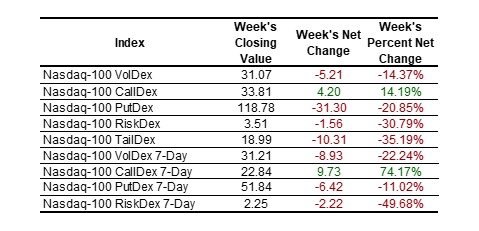
How to Use This Data…Where these indexes are in relationship to their 52-week ranges suggests they are neither particularly cheap nor expensive. While we prefer buying options or option spreads when options are relatively cheap, it is reasonable to execute trades that are long volatility (i.e., long options or option spreads) or short volatility in a defined-risk structure (short option spreads). Refer to last week’s edition to review our comments about how difficult it can be for long call positions to make money even when the market rallies because of the collapse of implied volatility when that happens, particularly following a really steep decline.

Nations Investor Optimism Index:
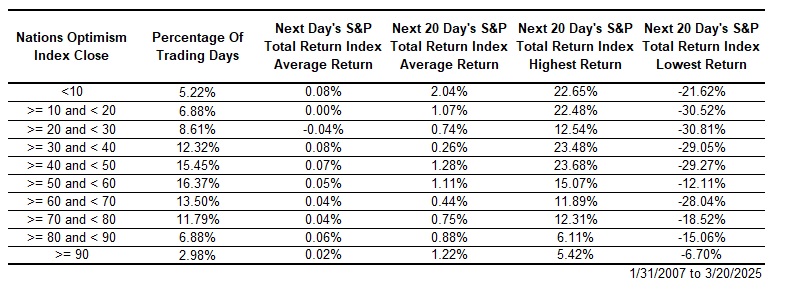
The Investor Optimism Index rose 445% for the week to close at 5.63 but that remains an abysmal level. The index has closed below 10 on just 5.22% of all trading days since initiation in January 2007.
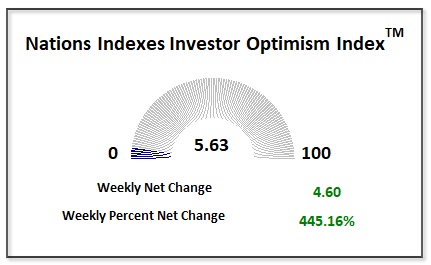
The index takes into account the current levels of S&P VolDex, TailDex, and RiskDex and compares them to their rolling 2-year ranges. It has not closed above 50 since January 24 and has not closed above 10 since April 2.
Our Optimism Index can be a great contrarian indicator since the best average subsequent 20 trading day returns come when the index closes below 10.00. However, as you can see in the far right-hand column, there are also some sickening additional drawdowns when the index closes below 10.00.
Other Equity Indexes:
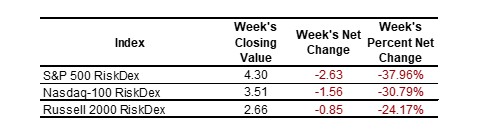
The Russell 2000 index of small capitalization stocks bucked the broader trend and gained 1.10% this week. It is now down 15.67% YTD and 23.75% from its 52-week high meaning it remains in “bear market” territory.
Option prices for the Russell 2000 index fell as you can see below. Unlike in the S&P 500 and Nasdaq-100, Russell 2000 CallDex fell slightly for the week.
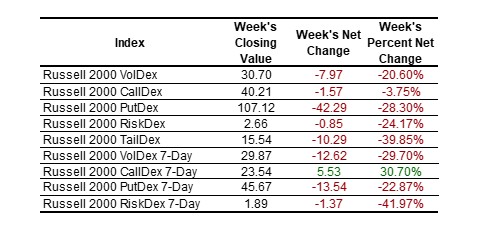
We continue to pay attention to the differences in RiskDex regimes for the 3 major equity indexes we follow. It is odd that Russell 2000 RiskDex is so much cheaper than RiskDex for the other indexes given the horrible price action in the Russell 2000 this year.
Why It Matters...Savvy traders can construct relative value trades to take advantage of this. You can see their respective values below.
Other Asset Volatility:
Treasury Bonds:
The yield on 10-year treasury notes and 30-year treasury bonds both fell this week as bond and note prices rebounded. The recent decline in note and bond prices was very surprising since they tend to rally in the face of a steep selloff in equity prices. To the degree that the sharp selloff in bond and note prices forced the administration’s hand in modulating tariffs, this will be an important market to watch. If yields rise above last week’s highs (4.877% in the 30-year and 4.493% in the 10-year) then expect additional easing of tariffs.
Treasury bond volatility eased as bond prices rallied. It is interesting that all the 30-day volatility numbers fell by similar amounts. That suggests traders do not have an outlook regarding the near-term direction for bond prices but are simply expecting less realized volatility.
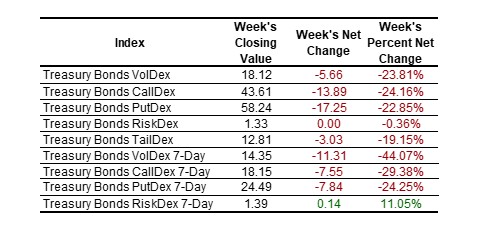
You’ll note that Treasury Bond VolDex has dropped back below the high reached in October. It ended the week at the 54th percentile of its 52-week range while PutDex closed at its 58th percentile and CallDex closed at its 42nd percentile.
Why It Matters...These percentile ranks tell use that traders believe the risk is to the downside rather than upside in treasury bonds.

Treasury bond puts remain expensive relative to call prices.

Last week we said, “The changing dynamic means defined-risk trades in the treasury space are appropriate. If the recently announced tariff exemptions for electronics imported from China mean that treasury bond puts will fall back from their very high level then selling cash-secured puts or put vertical spreads in TLT is likely to be profitable.” That certainly worked out this week.
Bitcoin:
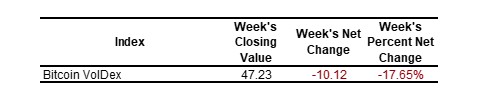
VolDex on bitcoin fell by 17.65% for the week along with implied volatility in other assets.
It’s only by using objective and consistently constructed data that it’s possible to use options on bitcoin during the next round of economic turmoil. We’ll continue to monitor our bitcoin volatility metrics for a road map for the future.
Bitcoin VolDex has resumed its trend to the downside as bitcoin shows less realized volatility and as traders sell options to take advantage of relatively expensive options. We expect this to continue although the nature of bitcoin means there will be some savage moves in price. We would not recommend owning at-the-money options.

Gold:
Gold has rallied strongly as the world searches for a safe haven that is not affiliated with any particular political entity as U.S. treasury bonds would be. This makes us wonder why bitcoin has not rallied in sympathy with gold.
Gold gained another 2.75% this week and closed at an all-time high on Wednesday. Despite this, CallDex fell on the week and it fell by more than VolDex and PutDex. This likely means option traders think the rally in gold has run its course and will require a new catalyst to resume its march higher.
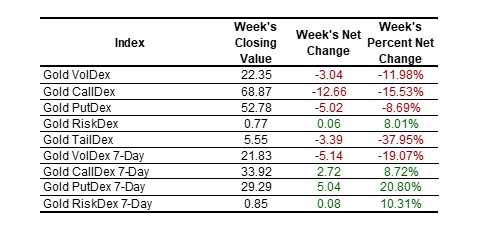
Gold VolDex remains very elevated, as you can see.

Gold CallDex remains above PutDex as you can see from RiskDex (RiskDex is the ratio of PutDex to CallDex so a RiskDex reading above 1.00 means out-of-the-money put options are more expensive than out-of-the-money call options and a reading below 1.00 means that relationship is reversed) so the market is showing call skew (greater implied upside than downside) but this is common for gold as you can see. The degree to which RiskDex has fallen below its historical range is striking.

Gold VolDex is at the 75th percentile of its 52-week range. Other percentiles are: CallDex 74th, PutDex 62nd, and RiskDex 26th.
Why It Matters...These percentile ranks should certainly guide us to use short volatility trade structures in gold regardless of directional thesis.
0DTE and 1DTE Options:
Zero day to expiration (ODTE) options accounted for 58.91% of all SPY option volume this week. That is a surprisingly high percentage given the ugly selloff on Wednesday but even then 0DTE options accounted for 53.54% of all SPY volume contrary to the recent trend that saw 0DTE volume falling off when the market itself falls.
Very short-dated volatility measures which use a variance swap methodology, as 1-day VIX does, inject significant error into the resulting measure because of the way out-of-the-money options trade in the hours before expiration. The VolDex at-the-money methodology is particularly suited for these very short-dated tenors.

Equities:
This week’s news was universally disappointing for the single names we cover. NVDA led the way lower, losing 8.51% for the week, nearly half of the previous week’s gain of 17.62%.

Despite these losses, volatility eased in each name thanks to less uncertainty regarding tariffs. This is the second consecutive week which saw VolDex decline for every single name we cover; clearly implied volatility is reverting.
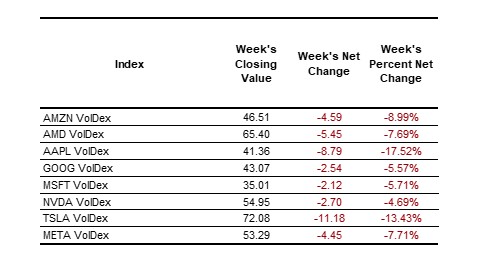
TSLA VolDex declined by more than for any other name with the exception of AAPL as Elon Musk steps out of the news spotlight, reducing, to some degree, concerns about what his involvement in the Trump administration means for Tesla’s sales and perception.

Why It Matters...TSLA options are still very expensive meaning that a range of short volatility strategies are available to accommodate a variety of directional opinions.
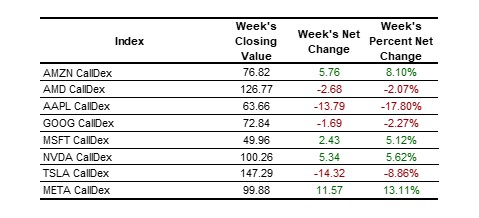
The most interesting action in the single names we cover was undoubtedly in CallDex. These measures were mixed with 4 climbing and 4 falling. Conversely, PutDex fell for all of the names we cover.
.
We’ll continue to comment during the week via our X account, @Nations_Indexes.
Scott's Weekly Commentary:
The market was on its way to a calming rally until Jay Powell said out loud what we were all thinking: tariffs are taxes and are likely to stoke inflation. That’s not a galloping surprise to anyone so now the question becomes, ‘Is it a one-time shock or will prices continue to spiral upward’. Unfortunately, there’s no way to know and I would be distrustful of anyone who avers an opinion strongly. Since the last time we encountered this sort of tariff regime was 1930 we can’t look back at history and find any analog for the sort of global economy we enjoy now.
The people who were worried that the recent hype and price action regarding AI was a bubble were correct although the bubble only partially inflated before tariffs entered the picture and changed the dynamic. In many ways, the fact that we didn’t get into a full-fledged, head shaking bubble like the internet bubble in 1999 is a good thing. AMD is 53% below its 52-week high (TSLA is as well but that’s a different story which has more to do with Elon than AI) and all the single names we cover are at least 20% below their 52-week highs.
For long term investors, this could be a time to buy some of these names. Last week I discussed the big banks that were due to report earnings and mentioned that JPM is the best of the lot. There are some relative bargains now in the AI space. NVDA’s forward PE is just 22.9. That’s cheap for company with NVDA’s growth prospects. And compare it to retailers like Costco (forward PE of 52.7) or Walmart (forward PE of 35.6). Given that NVDA PutDex is at 180.97 and CallDex is at 100.26, a risk reversal (selling the out-of-the-money put and using the proceeds to buy the out-of-the-money call) seems like a great strategy for an investor who wants to own the stock but wants to use options to improve the payoff profile. Any time you sell a put you have to be ready and able to buy the shares if they’re below the put strike price at expiration.
With RiskDex for both AAPL and MSFT above 2.00 (2.35 and 2.50 respectively), a risk reversal in these blue chip names also makes sense. Again, you have to be ready to buy the shares if they’re put to you but both of these names are “set and forget” investing ideas.
Finally, bitcoin’s inability to rally while gold is making new all-time highs is concerning. Shouldn’t the world be looking for an asset that is a store of value but which is geopolitically agnostic? Shouldn’t that be bitcoin?
Everyone at Nations Indexes hopes you have a healthy and profitable week.
Scott
