

Your Week’s Volatility Market Commentary — Information Is Your Edge
Stocks Strong as Trade Tensions Ease, Earnings Impress
The Weekly Takeaway:
- The S&P 500 gained 2.92% for the week as worries about tariffs fade and as earnings impressed with MSFT, META, AAPL, and AMZN all beating earnings expectations. The index is now down 3.31% YTD and is 7.50% below its 52-week high;
- The Nasdaq-100 gained 3.45% this week after gaining 6.43% last week. Much of the rally was thanks to those tech names. The index is now down 4.33% YTD and is 9.54% below its 52-week high;
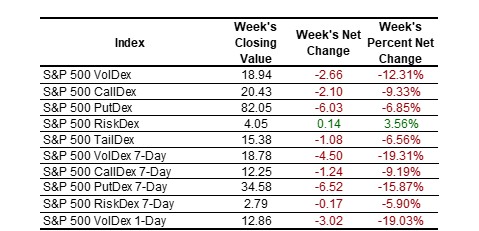
- VolDex (ticker VOLI) fell 12.31% for the week to close at 18.94. It has now dropped for 4 consecutive weeks as a solid earnings season grabs headlines rather than tariffs;
- TailDex (ticker TDEX) fell by 6.56% after falling 21.62% and 25.32% in the previous weeks. Traders have been very quick to short these options following recent downdrafts;
- Nasdaq-100 VolDex fell by 11.36% as tech earnings surprised to the upside. Implied volatility tends to ease as catalysts pass and that was the case this week with earnings released and jobs data also surprising to the upside;
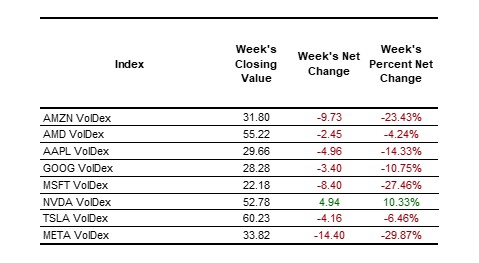
- VolDex fell for all the individual names we cover with the exception of NVDA which saw VolDex gain 10.33%;
- CallDex on all the single names we cover fell, bucking last week’s trend. As we’ll discuss, speculators were clearly long out-of-the-money calls in tech names for earnings;
- The Nations Investor Optimism Index rose 15.34% to close at 13.03;
- Nations Indexes is happy to announce that, starting with the coming week, we’re expanding the range of broad markets and individual names we cover.

Equity Index Volatility:
Implied volatility and option prices continued to fall as stocks rally thanks to the tariff discussion moving from center stage and as companies reported positive earnings surprises.
Google set the stage in the previous week with its earnings beat and several big names did the same this week including MSFT, META, AMZN, Morgan Stanley, Pfizer, and AAPL. AAPL ended the week lower by 1.88% as concerns about iPhone production in China continue to worry investors.
VOLI fell by 12.31% to close at 18.94 and is now at just the 28th percentile of its 52-week range. However, the average closing price for the past 52-weeks is just 14.97 so while implied volatility is lower, it is by no means historically low.
TDEX fell by 6.56% this week to close at 15.38. That is the 26th percentile of its 52-week range but again, don’t be fooled. The 52-week closing price for TDEX is 13.93.
Why It Matters…Historical data for all our indexes is available to subscribers at the Everything! level and they allow option traders to understand the context of the current option pricing environment. Despite their recent weakness, option prices still remain historically high and you can see that in the VOLI chart above. Volatility is mean-reverting and that is a phenomenon traders can take advantage of in both directions. But you have to understand what is normal, what the “mean” is, in order to do so.

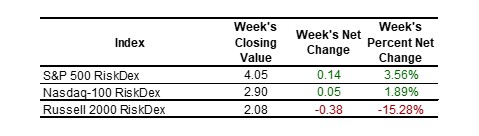
S&P RiskDex rose by 3.56% on the week as out-of-the-money call prices fell by more than out-of-the-money put prices. RiskDex is still above 4.00 which signals remnants of worry so this is a metric we will continue to watch. There is a natural floor to RiskDex and in the S&P it is 2.00 but, interestingly, each asset has its own RiskDex regime. Savvy traders will take advantage of this.

You can see the week’s volatility results for the S&P 500 below.
The Nasdaq-100 had a great week, led by MSFT which gained 11.08% and META which gained 9.09%. Nearly every volatility measure fell with 7-day measures leading the way lower as you would expect in the wake of earnings releases. As in the S&P, RiskDex rose a bit as out-of-the-money call prices fell by more than out-of-the-money put prices but the effect was small.

Nasdaq-100 VolDex closed at 23.06, the 31st percentile of its 52-week range but the average over that period is 20.04.

The Nasdaq-100 RiskDex chart above is interesting. We’re not fans of trying to use technical analysis on volatility metrics but there seems to be an upward bias indicating that put prices are slowing gaining on call prices. Nasdaq-100 RiskDex ended the week at 2.90 so it’s still below 3.00 and it may be a relative bargain now. That would suggest a collar for an owner of QQQ—a collar sells an out-of-the-money covered call and uses the proceeds to buy an out-of-the-money put for protection. A short call spread can replace the covered call for traders who are not long the shares. This is generally a bearish structure.
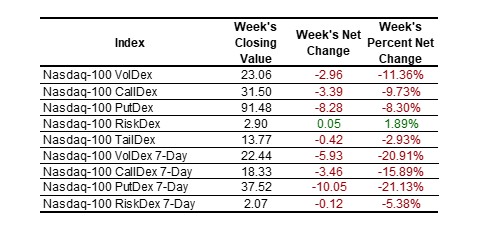
Last week we noted “the buying interest in Nasdaq-100 CallDex and willingness of traders to sell puts, particularly deep out-of-the-money puts is instructive.” That certainly worked in the context of earnings this week.
Why it Matters...This week’s move in RiskDex seems to be sending a similar sort of message.
Nations Investor Optimism Index:
The Investor Optimism Index rose another 15.34% this week to close at 13.03 but that’s not very impressive.
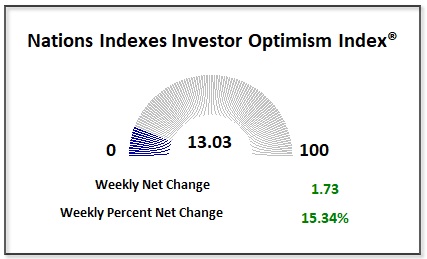
The index takes into account the current levels of S&P VolDex, TailDex, and RiskDex and compares them to their rolling 2-year ranges. It has not closed above 50 since January 24.
Other Equity Indexes:
The Russell 2000 index of small capitalization stocks gained 3.22% this week. It is now down 9.39% YTD and is just 18.07% below its 52-week high meaning it is no longer in “bear market” territory. Stock market returns come with small victories and this week’s performance for the Russell 2000 is a small victory.
The metric that stands out for the Russell is CallDex which rallied by 6.35% this week. It looks like some bulls are dipping their toes in the Russell water but want to define their risk by buying call options.
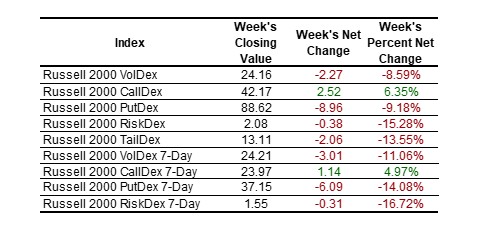
Last week we pointed out that, “investors choose to get defined risk exposure to the Russell 2000 by buying calls rather than the shares” and it seems that trend is continuing. Many of the companies in the Russell aren’t doing very well and tariff concerns can weigh down smaller names but maybe they’re going to lead the way back higher.
Why It Matters...Savvy traders will take note of these tendencies and factor them into their trade structures.
Other Asset Volatility:
Treasury Bonds:
The yield on 10-year treasury notes rose slightly on the week as bond and note prices fell slightly.
Treasury bond volatility eased across the board and the month’s big catalyst for fixed income, the jobs report, passed with slightly more jobs created in April than the market had expected.
RiskDex continued to fall as fears of a dramatic “Sell America” inspired downdraft in treasury bond prices faded.
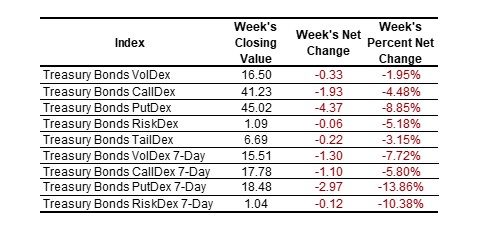
Treasury Bond VolDex has dropped well below the high reached in October and is back in the mid-teens level where it spent much of the last 52 weeks.

Why It Matters...This means that while long volatility trades in the equity world are still facing relatively high volatility levels, that headwind is weaker in the treasury world.

Treasury bond puts remain somewhat expensive relative to calls although this continues to unwind. This is a set up to take advantage of now. Traditionally, out-of-the-money calls in treasuries are more expensive than puts. We’ll be watching to see if RiskDex can fall back below 1.00 meaning PutDex is below CallDex.
Bitcoin:
VolDex on bitcoin fell by 5.12% after falling 5.15% last week and falling 17.65% during the week before that. Friday’s closing value of 42.51 is an all-time closing low for Bitcoin VolDex.
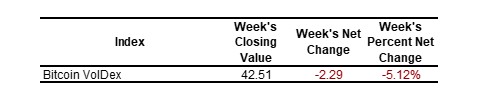
Two weeks ago we pointed out that, “Bitcoin VolDex has resumed its trend to the downside as bitcoin shows less realized volatility and as traders sell options to take advantage of relatively expensive options. We expect this to continue although the nature of bitcoin means there will be some savage moves in price. We would not recommend owning at-the-money options.”
That clearly worked as Bitcoin VolDex continues to drop from its initial level of 61.66 on December 6, 2024.
Again, we’re not fans of applying technical analysis to volatility measures but Bitcoin VolDex is clearly showing lower highs and lower lows. A jump above 55 would be something to take advantage of with defined-risk structures that are short volatility.

Gold:
Gold has been on a tear lately as it serves as the safe haven treasuries have failed to be, but it fell 2.22% this week as fundamentals lead the way in the equity world, taking over from geopolitics.
Gold VolDex fell by 9.13% this week as gold moved out of the spotlight and CallDex and PutDex fell in sympathy.

The interesting move is in TailDex which gained 7.68%. There is usually very little interest in “tail protection” in gold so this is a metric we’ll focus on. Last week we pointed out that, “that the risk in gold has shifted to the downside is particularly obvious in the 7-day RiskDex measure.”
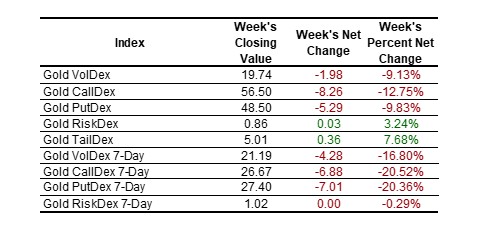
We’ll continue to watch for weakness in gold although worrying about a “tail event” seems pretty farfetched.
0DTE and 1DTE Options:
Zero day to expiration (ODTE) options accounted for 59.07% of all SPY option volume this week. It accounted for more than 60% of all SPY option volume on Monday and Tuesday.
Very short-dated volatility measures which use a variance swap methodology, as 1-day VIX does, inject significant error into the resulting measure because of the way out-of-the-money options trade in the hours before expiration. The VolDex at-the-money methodology is particularly suited for these very short-dated tenors.

Equities:
This week’s news was good for the single names we cover with the exception of AAPL. MSFT led the way higher, gaining 11.08% after gaining more than 6% in the previous week.

VolDex fell in most of these names, as you would expect given their performance, worries about tariffs, and earnings releases. NVDA is the outlier and we’ll discuss that more below.
RiskDex in these names paints a more nuanced picture.
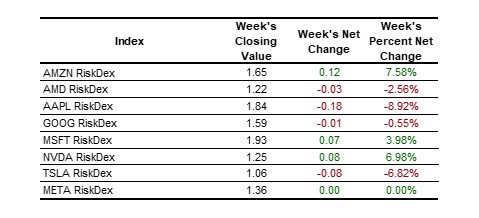
TSLA RiskDex is again approaching 1.00 after spending much of last year below that level. RiskDex below 1.00 means CallDex (out-of-the-money call prices) is higher than PutDex (out-of-the-money put prices). RiskDex below 1.00 describes very bullish sentiment for any single name.

TSLA bulls continue to buy calls and sell puts, driving down RiskDex. As we said above, RiskDex has a lower bound and in TSLA it appears to be about 0.55. Any trade that takes advantage of RiskDex’s trend to the downside should take note of that.
NVDA is out of phase with other earnings cycles; it reports on May 28. That mean our 30-day measures catch that report but it also means NVDA volatility isn’t going to fall in sympathy with other tech names. That’s one reason NVDA VolDex was in the green this week.

We are fans of taking advantage of the “volatility crush” that occurs following big catalysts and smart traders will be taking advantage of that in NVDA. Short put spread positions have worked in the names that have reported and given that NVDA’s forward PE is just 26, they make sense in NVDA.
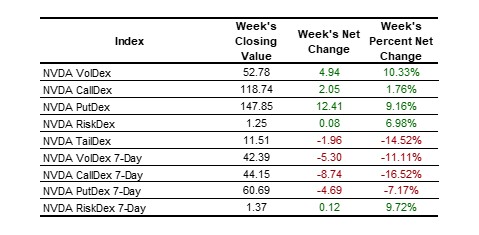
When RiskDex falls below 1.00 that signals that markets see more implied upside than implied downside for the stock. RiskDex for an individual name can stay below 1.00 for some time, and can fall further below 1.00. But there is a natural lower bound for RiskDex and savvy traders will take advantage of that.
We’ll continue to comment during the week via our X account, @Nations_Indexes.
Scott's Weekly Commentary:
The stock market is bouncing back nicely as we’ve all been taught to buy the dip. It seems a more rational tariff policy is forming although I’m not certain why we needed as much turmoil and volatility as we got. I still believe China will be looking for an opportunity to stand up to us.
Our stock market loved the fact that China said it is willing to hold talks about tariffs but that doesn’t mean they’re going to concede anything. China’s leadership would like to see more of what they make be consumed domestically. They may not be particularly worried about exports falling if that means it helps turn China into a consumer economy.
The consumer confidence reports are still distressing although Friday’s jobs report being better than expected is a relief. Economists will wonder about the timing of the worst news during the last month versus hiring decisions but everyone has to worry about something.
The real reason to feel better is earnings. The news has been almost universally great and it’s nice to see buybacks being implemented when stocks are off their highs.
Everyone at Nations Indexes hopes you have a healthy and profitable week.
Scott
