
The Weekly Takeaway:
- The S&P 500 continued its rally and gained 0.91% this week thanks to strong earnings, renewed optimism regarding AI, and hopes for de-escalation of the U.S./Iran conflict despite elevated crude oil prices related to the Strait of Hormuz. The index is now up 5.62% for the year;
- The Nasdaq-100 gained 1.49% this week as tech earnings were cheered by the market. The index is now up 9.74% for the year;
- Crude oil futures rose another 7.35% this week as the ceasefire held but the Strait of Hormuz remained closed – approximately 25% of the world’s crude oil transits the Strait. Futures ended the week at 102.26 a barrel;
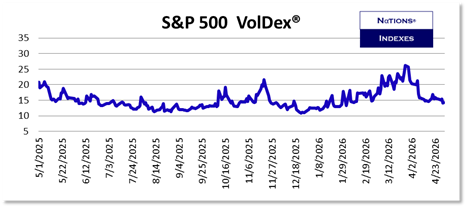
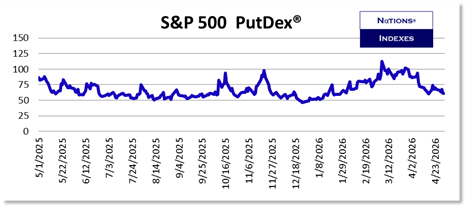
- S&P 500 VolDex (ticker VOLI) fell by 8.33% to close at 14.31. However, it rose by 1.21% on Friday despite the S&P gaining 0.29% that day. It is very odd for VOLI to gain ground on a Friday when the S&P rallies;
- S&P 500 RiskDex fell by 3.34% and is once again below its long-term average value. You can learn more about RiskDex at Learn More About RiskDex;
- Every 30-Day volatility metric for the S&P 500 fell on the week with the exception of 7-Day CallDex which rose by 5.34%. This signals continued short-term optimism;
- S&P 500 VolDex is at the 22nd percentile of its 52-week range while S&P 500 CallDex is at the 47th percentile of its 52-week range;
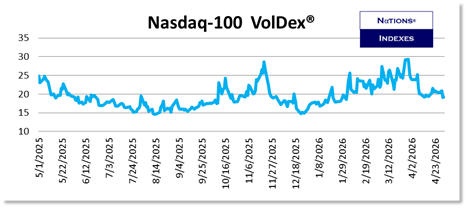
- VolDex on the Nasdaq-100 fell by 6.55% to close at 19.27. That is the 32nd percentile of its 52-week range;
- Nasdaq-100 30-Day and 7-Day CallDex both rose signaling even more optimism for tech names than for the broad market;
- Nasdaq-100 TailDex fell by 9.41% to close at 12.28 which is the 21st percentile of its 52-week range. You can learn more about TailDex at Learn More About TailDex;
- The yield on Treasury Notes rose 6.8 basis points this week and closed at 4.378% after spending much of the week above 4.400%. This week’s inflation data pointed to even higher prices than expected;
- Volatility in Treasury Bonds was generally higher this week with 30-Day tenors for VolDex, CallDex, PutDex, and TailDex all gaining ground;
- The individual equities we cover were generally higher with only MSFT (-2.40%), NVDA (-4.72%), META (-9.82%), and AVGO (-0.35%) falling. GOOG was the big gainer (+11.95%);
- VolDex was lower on every individual name we cover with the exception of NVDA (+0.90%) as many names reported earnings and experienced the typical post-earnings “Vol Crush”. NVDA reports on May 20;
- The Nations Indexes Optimism Index® rose by 3.18% to close at 85.78. Our Optimism Index is always available in real-time on our home page at NationsIndexes.com;
- You can always learn more about all our indexes at Learn More About Our Indexes.
Equity Index Volatility:
The S&P 500 rose 0.91% on the week to close at 7230.12 after making a new all-time high of 7272.52 earlier on Friday. Stocks managed to rally despite crude oil climbing 7.35% for the week. This is the second consecutive week this scenario (weekly gains with new all-time high posted on Friday despite much higher crude oil prices) has played out. This is an expression of confidence in the prospects for technology names.
S&P 500 PutDex fell by 10.37% to close at 60.99. The 7.61% weekly decline in CallDex is interesting and might be seen as tempering optimism but it has rallied from very depressed levels; it closed at just 7.13 on March 6. This week’s close of 16.69 puts it at the 47th percentile of its 52-week range.
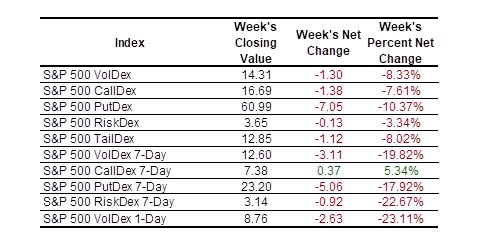
S&P 500 PutDex continues to ease and ended the week at just the 22nd percentile of its 52-week range. The 50 level will be important for PutDex and if it dips below that level then protective put or put spread positions should be considered. PutDex measures the normalized price of the 30-Day, 1 standard deviation out-of-the-money put option; that corresponds to a 16 delta put.
Historical metrics (Average, median, 10th percentile, 25th percentile, 75th percentile, and 90th percentile) for all our indexes are available to subscribers at NationsIndexes.com.
Why It Matters…Historical data for all our indexes is available to subscribers at the Everything! level and they allow option traders to understand the context of the current option pricing environment. You have to understand what normal is in order to do so.
Nasdaq-100 VolDex fell by 6.55% as many of the bigger names (MSFT, META, GOOG, AMZN, and AAPL) reported earnings. Nasdaq-100 CallDex rose in both the 7-Day and 30-Day tenors signaling continued optimism.
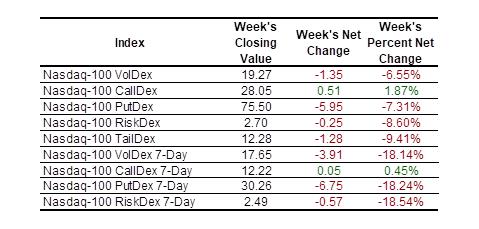
Nasdaq-100 VolDex is at the 32nd percentile of its 52-week range.
You can learn more about VolDex at Learn More About VolDex.
Why It Matters…Traders have to have the objective data provided by our indexes to trade in a way that doesn’t rely on hunches or guesses.
Nations Investor Optimism Index®:
The Investor Optimism Index® rose by 3.18% to close at 85.78.
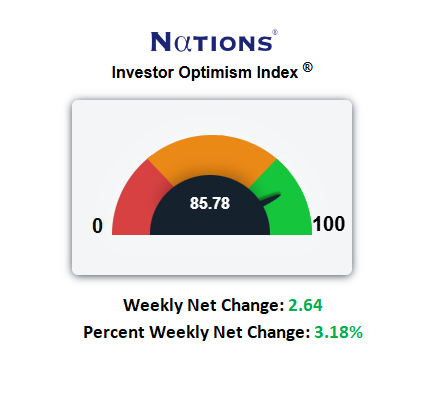
The index takes into account the current levels of S&P 500 VolDex, TailDex, and RiskDex and compares them to their rolling 2-year ranges. It is plotted on a 0 to 100 scale.
Our Optimism Index is now available in real-time on our home page at Nations Optimism Index.
Option Window®:
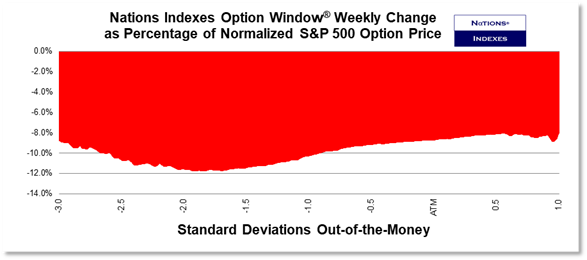
S&P 500 Option Window fills in the blanks between TailDex, PutDex, VolDex, and CallDex and reveals how trade flows were driving option prices. Since Option Window calculates normalized option prices at fixed points of moneyness any changes are driven by option flows rather than movement in the underlying S&P 500.
S&P 500 option prices were lower across the entire skew.
Term Structure:
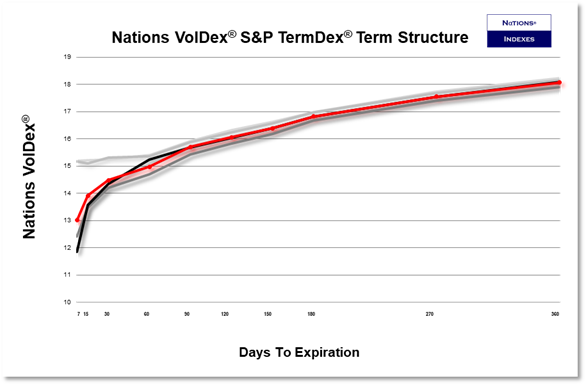
The Nations TermDex® measure of VolDex term structure illustrates S&P 500 VolDex for various tenors. It provides insight into both near-term and longer-term expectations for volatility in the S&P 500.
Term structure at the close on Friday (in red) remains upward-sloping from left to right. This suggests only moderate concern for the S&P 500 over the next 7 days.
1DTE Options:
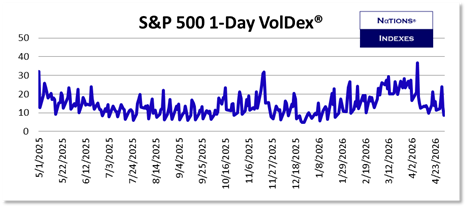
S&P 500 1-Day VolDex fell by 23.11% and is once again convincingly below 10.00.
Very short-dated volatility measures which use a variance swap methodology, as 1-day VIX does, inject significant error into the resulting measure because of the way out-of-the-money options trade in the hours before expiration. The VolDex at-the-money methodology is particularly suited for these very short-dated tenors.
Other Asset Volatility:
Treasury Bonds and Notes:
Bond futures fell nearly one point as crude oil rose again this week and inflation data showed consumer prices are spiking.
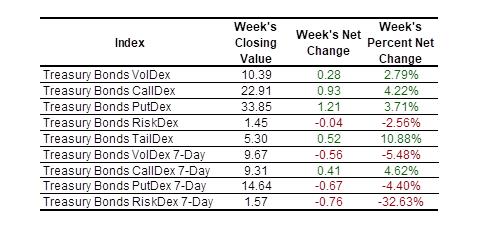
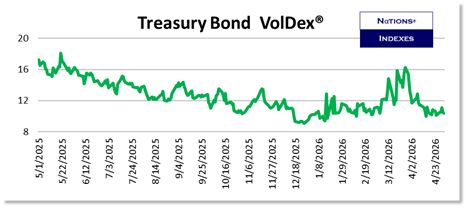
Treasury Bond option prices rose in response with VolDex gaining 2.79%.
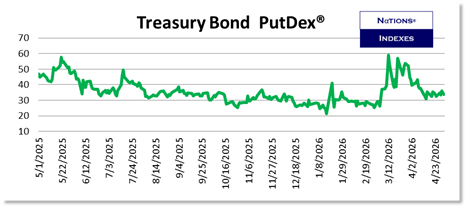
Treasury Bond CallDex closed at just the 10th percentile of its 52-week range signaling little hope for a rally. PutDex closed at the 33rd percentile of its 52-week range so traders’ directional expectations for Treasury Bonds are clearly downward.
Precious Metals:
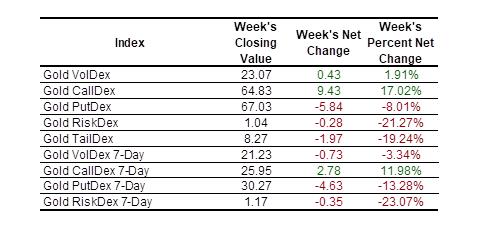
Gold fell by 2.13% on the week and lost ground on 4 of the 5 days as inflation makes gold less attractive.
Equities:
We have expanded the list of single names we cover to include not only the most dynamic stocks in the S&P 500 and the stocks with the highest option volume, but also the largest names in the S&P 500.
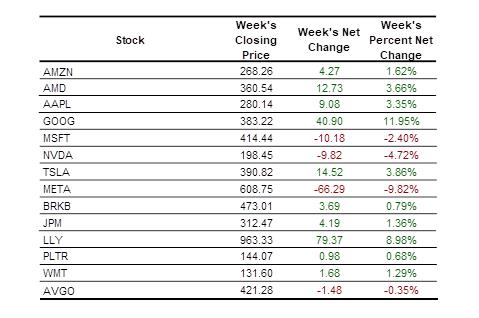
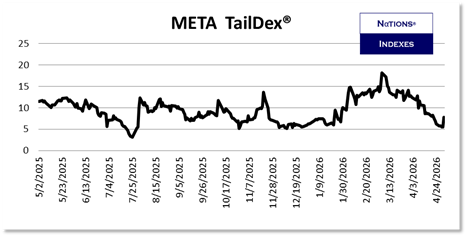
GOOG was the big gainer this week with a 11.95% rally. META fell by 9.82% despite beating earnings expectations as investors expressed concern over future AI-related capital expenditures.
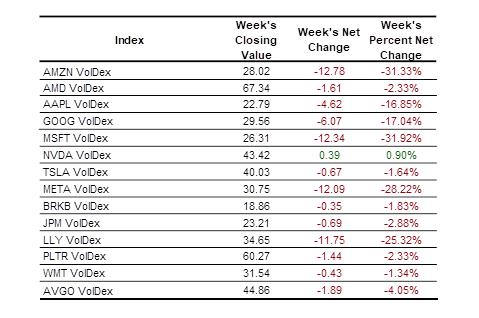
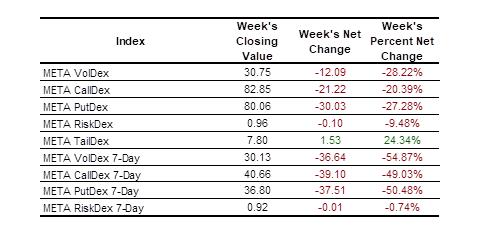
META displayed the typical post-earnings volatility crush in most volatility metrics but the rally in META TailDex is noteworthy. However, it is rallying from an historically low level as you can see and investors who are worried about the cap ex drag on earnings have an opportunity to place inexpensive hedges. Any META TailDex reading below 5.50 should be considered an opportunity to place very inexpensive hedges.
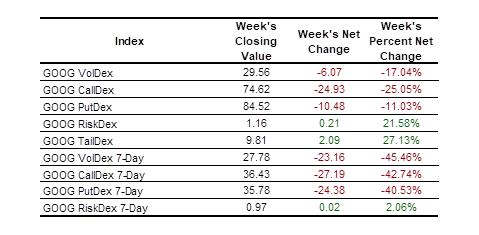
GOOG gained 11.95% on the week and now sports a market cap of $4.6 trillion, second only to NVDA.
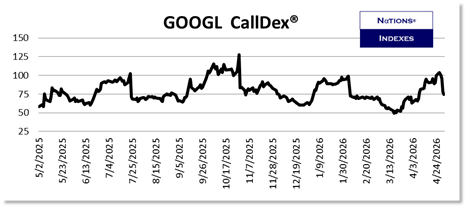
GOOG CallDex displays earnings-related seasonality so it is dropping, but any reading below 60.00 would make out-of-the-money calls interesting for GOOG bulls or investors interested in buying calls for stock replacement.
You can learn more about CallDex at Learn More About CallDex.
We’ll continue to comment during the week via our X account, @Nations_Indexes.
Scott's Weekly Commentary:
The stock market does not seem to care that crude oil is up 52% since the start of the war and that inflation, as measured by PCE, is spiking. This is explained by the idea that hopes for AI – hopes not regarding how it will impact lives but hopes regarding profitability for providers and users – are currently profound enough to overcome more prosaic worries about higher interest rates making stocks less attractive. That is unlikely to last forever given that the current dividend yield for the S&P 500 is about 1.15% which is well below long-term averages.
If stocks yield 70% less than 10-year Treasury Notes then something ultimately has to give. But AI-driven optimism will likely continue to carry the day. The internet started changing our lives 25 years ago and the changes have been profound. I think the changes generated by AI will be an order of magnitude greater although we’re not close to being there yet. AI is taking up a lot of people’s time right now but from what I see it isn’t improving productivity yet, at least not to a degree commensurate with the investment in time by users and time and money by AI providers.
It’s also too early to be picking winners and losers. Google didn’t go public until 2004 and Yahoo had already peaked in popularity. MySpace, Napster, and a host of other sites are answers to trivia questions now despite being powerhouses in their prime. The same will be true for today’s popular AI names and I bet that 25 years from now the most popular AI engine will be less than 25 years old – meaning it doesn’t exist today.
It all seems so obvious in retrospect but it will be fun to watch.
Everyone at Nations Indexes hopes you have a profitable week and that all American service members have a safe one.
Scott
