The Weekly Takeaway:
- The S&P 500 lost 2.12% this week. That is the fifth straight weekly loss for the S&P 500 and it is now down 6.96% for the year;
- The Nasdaq-100 lost 3.20% this week. It is down 8.38% for the year;
- Crude oil futures rose 3.15% to close at $101.18;
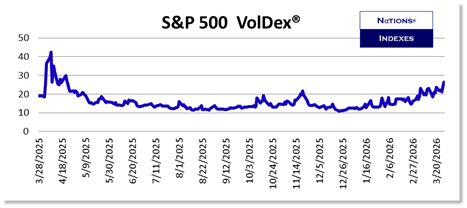
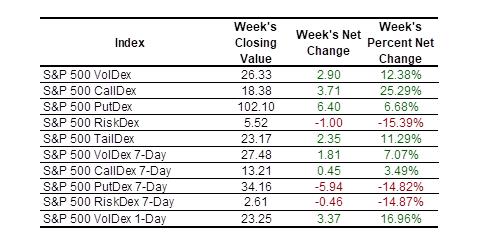
- S&P 500 VolDex (ticker VOLI) rose 12.38% to close at 26.33. That is the highest level since April’s selloff due to imposition of trade tariffs;
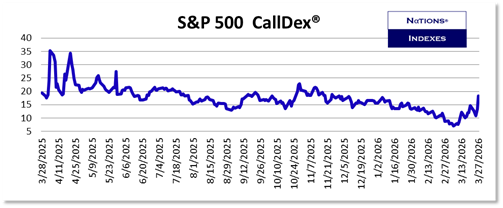
- S&P 500 CallDex rose 25.29% this week after rising 20.07% during the previous week. As we said presciently last week, this is a function of traders reaching to buy implied volatility rather than bullish sentiment;
- You can learn more about CallDex at Learn More About CallDex;
- Every 30-Day volatility metric for the S&P 500 was higher on the week with the exception of RiskDex which fell 15.39% only because CallDex rose much more than PutDex;
- VolDex on the Nasdaq-100 rose by 8.74% to close at 29.18;
- Nasdaq-100 30-Day volatility metrics echoed those for the S&P 500 in that they all rose with the exception of RiskDex which fell only because of the size of the gains made by CallDex;
- You can learn more about RiskDex at Learn More About RiskDex;
- The yield on Treasury Notes rose another 4.9 basis points this week and closed at 4.440%. It is up 47.8 basis points (i.e., 0.478 percentage points), since the start of the war;
- Volatility metrics for Treasury Bonds generally eased this week as the pace of price declines (and yield increases) similarly eased. But Treasury Bond RiskDex is still historically elevated expressing more implied downside for Bonds than implied upside;
- Gold bounced back and gained 0.74% for the week thanks to a gain of 3.11% on Friday. Silver gained 2.91% for the week;
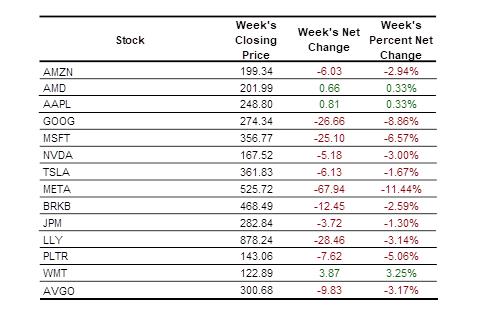
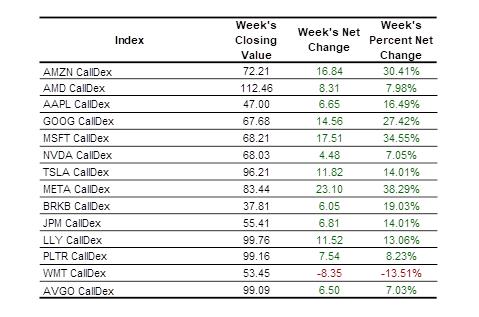
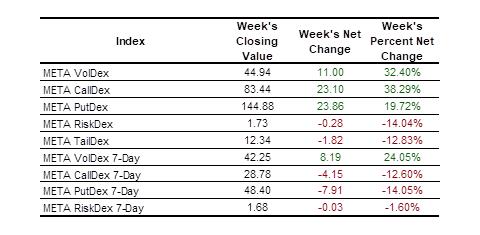
- The individual equities we cover were generally lower this week with AMD, AAPL, and WMT bucking the trend and gaining ground. META fell by 11.44% after a California jury found the company (along with Google’s Alphabet) liable in a landmark social media addition case. META VolDex rose 32.40% on the week;
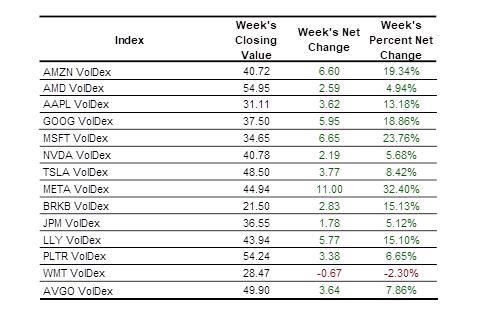
- Every VolDex measure on the single names we cover was higher with the exception of WMT (-2.30%). VolDex on AMZN, AAPL, GOOG, MSFT, META, BRKB, and LLY all gained more than 10%;
- The Nations Indexes Optimism Index® fell by 2.40% to close at 60.49. Our Optimism Index is always available in real-time on our home page at NationsIndexes.com;
- You can always learn more about all our indexes at Learn More About Our Indexes.
Equity Index Volatility:
The S&P 500 lost another 2.12% for the week despite starting the week with a gain of 1.15% on Monday. Concern about the war with Iran eventually overwhelmed the early optimism.
The price of crude oil and its impact on inflation has become a problem for our stock market. The market was buoyed during the last half of last year by expectations that the Federal Reserve would be cutting short-term interest rates this year. At this point last month the market expected rates would be lower by 61.9 basis points (0.619 percentage points) at the end of the year from where they are now. The market now believes rates will be slightly higher at the end of the year. That is weighing on stocks.
S&P 500 CallDex once again posted big gains for the week. As we said presciently last week, “Don’t be fooled by the rally in S&P 500 CallDex. It is a function of traders buying implied volatility delta-neutral in the cheapest strikes possible – this is almost always out-of-the-money calls – rather than bullishness.” This is still the case.
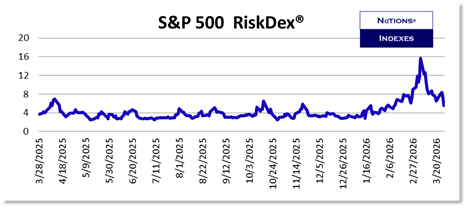
While RiskDex fell this week, it is falling from unprecedented levels and the current price action should not be mistaken for bullish sentiment. The average close for S&P 500 RiskDex since inception (1/31/2005) is 3.77 and the median close is 3.43 so current levels remain elevated and pessimistic.
Historical metrics (Average, median, 10th percentile, 25th percentile, 75th percentile, and 90th percentile) for all our indexes are available to subscribers at NationsIndexes.com.
Why It Matters…Historical data for all our indexes is available to subscribers at the Everything! level and they allow option traders to understand the context of the current option pricing environment. You have to understand what normal is in order to do so.
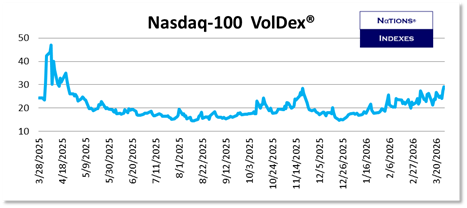
Nasdaq-100 VolDex rose by another 8.74%.
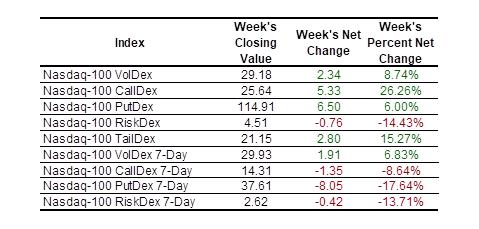
Nasdaq-100 VolDex is at the 45th percentile of its 52-week range.
You can learn more about VolDex at Learn More About VolDex.
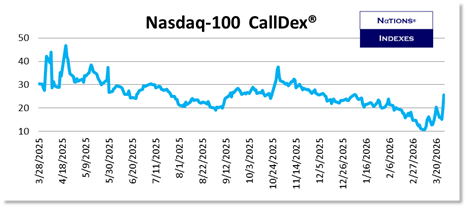
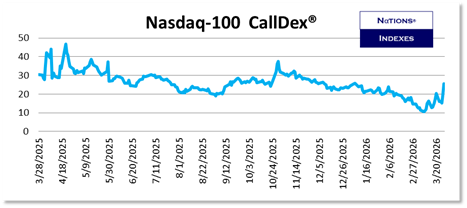
Nasdaq-100 CallDex rose by 26.26%, mimicking the move in the S&P. Again, this should not be construed as bullish.
Why It Matters…Traders have to have the objective data provided by our indexes to trade in a way that doesn’t rely on hunches or guesses.
Nations Investor Optimism Index®:
The Investor Optimism Index® fell by 2.40% to close at 60.49.
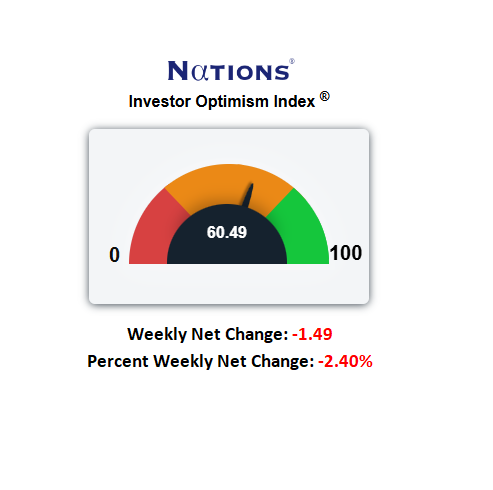
The index takes into account the current levels of S&P 500 VolDex, TailDex, and RiskDex and compares them to their rolling 2-year ranges. It is plotted on a 0 to 100 scale.
Our Optimism Index is now available in real-time on our home page at Nations Optimism Index.
Option Window®:
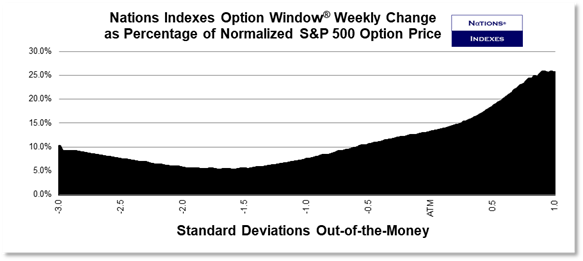
Option Window fills in the blanks between TailDex, PutDex, VolDex, and CallDex and reveals how trade flows were driving option prices.
Option prices were higher across the entire skew. Option Window is particularly helpful this week. Professional volatility traders want to be long strike prices they believe the S&P 500 will move away from and short strike prices they believe the S&P 500 will move toward. So this week’s Option Window tells us they believe the S&P 500 will continue to move lower over the next 30 days (and away from strike prices which are currently above at-the-money) and toward those strike prices that are 1.5 to 2.0 standard deviations below at-the-money. That corresponds to approximately 5650 to 5700 in the S&P.
Term Structure:
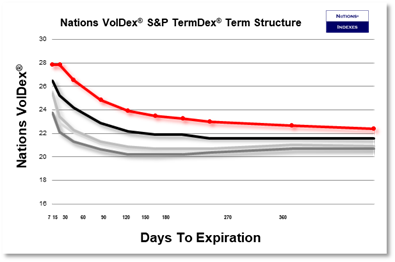
The Nations TermDex® measure of VolDex term structure illustrates S&P 500 VolDex for various tenors. It provides insight into both near-term and longer-term expectations for volatility in the S&P 500.
Friday’s closing term structure, in red (other days of the week are in black and gray), remained steeply inverted. This is a signal that traders are worried about volatility in the short term.
1DTE Options:
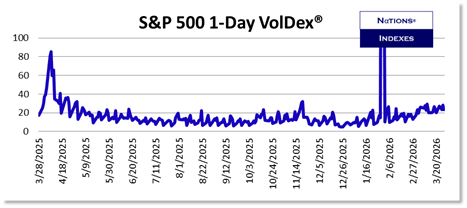
S&P 500 1-Day VolDex rose by 16.96% to close at 23.25. That reading says traders expect a move of at least 1.45% over the next trading day.
Very short-dated volatility measures which use a variance swap methodology, as 1-day VIX does, inject significant error into the resulting measure because of the way out-of-the-money options trade in the hours before expiration. The VolDex at-the-money methodology is particularly suited for these very short-dated tenors.
Other Asset Volatility:
Treasury Bonds and Notes:
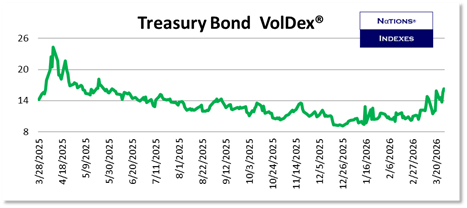
Bond futures have dropped in price by 5.27% since the war began. Some Treasury Bond volatility measures fell slightly on the week signaling that traders believe Bond prices will be less volatility over the next 30 days than they were over the previous 30 days but this is a comment on volatility and not direction.
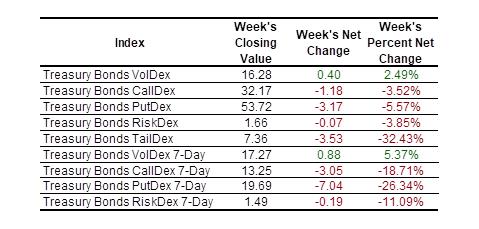
Treasury Bond VolDex closed at the 47th percentile of its 52-week range.
Precious Metals:
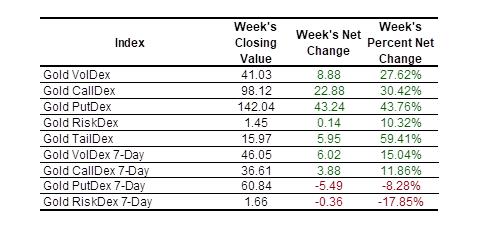
Precious metals managed to rebound slightly from last week’s carnage; gold rose by 0.74% and silver rose by 2.91%. Nonetheless, volatility metrics in gold were very strong this week with Gold VolDex gaining 27.62%. The price action in options signal more volatility ahead for gold.
Equities:
We have expanded the list of single names we cover to include not only the most dynamic stocks in the S&P 500 and the stocks with the highest option volume, but also the largest names in the S&P 500.
Most of the names we cover fell along with the broad market. META and GOOG were the big losers thanks to the loss in court in California, but MSFT fell by 6.57% and PLTR lost 5.06%.
VolDex was higher for every name with the exception of WMT.
CallDex was particularly strong for the equities we cover as traders reached for out-of-the-money calls to get long volatility as cheaply as possible. As with the S&P 500, this is not bullish.
Thinking of selling a covered call in one of these names? We'll provide the objective data you need to make an informed decision.
30-Day volatility measures generally rose for META. RiskDex fell only because CallDex rose by more than PutDex for the reasons we’ve discussed above. The decline in TailDex is interesting but we don’t believe traders should read too much into that given the 19.72% rally in PutDex. This may be an indication that traders are buying just out-of-the-money puts and selling deeper out-of-the-money puts as a bearish spread.
You can learn more about PutDex here.
All our index values are available in real-time to subscribers.
We’ll continue to comment during the week via our X account, @Nations_Indexes.
Scott's Weekly Commentary:
The administration’s moves to ease tensions with Iran are no longer placating the U.S. stock market. The 10-day delay in targeting Iranian infrastructure should have provided a durable boost to the S&P but after Monday’s rally the optimism faded and the action on Thursday and Friday was horrible. A new playbook is going to be needed for very short-term traders.
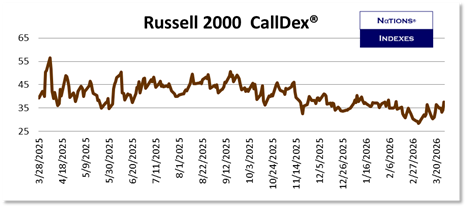
Earlier this year we were discussing how cheap CallDex (the normalized price of out-of-the-money call options) had gotten in the S&P 500. That is no longer the case as vol traders have reached to buy the cheapest vol possible which is almost always in the out-of-the-money calls. This is not bullish.
The other belligerents will have plenty to say about how the war unfolds and when it ends.
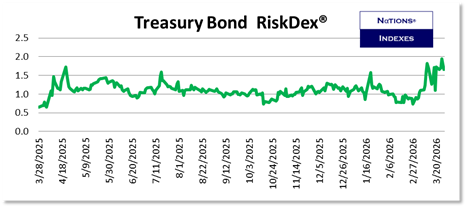
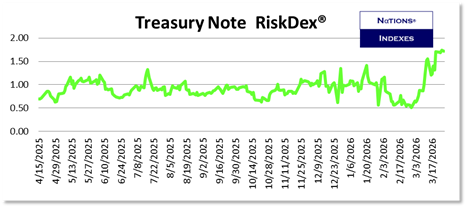
RiskDex did a great job of signaling the downturn in the S&P 500. It can be a very useful indicator because it distills fear and greed or optimism and pessimism. While it has eased from VERY extreme levels for the equity indexes from earlier this year, it remains elevated for Treasury Bonds and Treasury Notes as you can see below. That should tell us something about the course of interest rates over the next 30 days.
Everyone at Nations Indexes hopes you have a profitable week and that all American service members have a safe one.
Scott
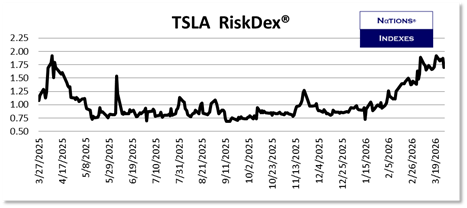
And we revisit TSLA RiskDex because we discussed it last week.