
The Weekly Takeaway:
- The S&P 500 managed to gain 0.13% for the week despite losing 1.24% on Friday as interest rates spiked. The index is now up 8.22% for the year;
- The Nasdaq-100 lost 0.38% this week and lost 1.54% on Friday as traders and investors sold names that had posted big gains recently. The index is now up 15.35% for the year;
- Crude oil futures rose 7.22% this week and closed at 101.52;
- The yield on Treasury Notes rose 23 basis points this week and closed at 4.595%. The yield on Treasury Bonds rose 18 basis points and closed at 5.128%. The last time the 30-year yield was appreciably above this level was 2007;
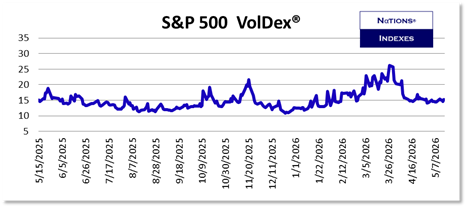
- S&P 500 VolDex (ticker VOLI) rose by 4.87% to close at 15.23;
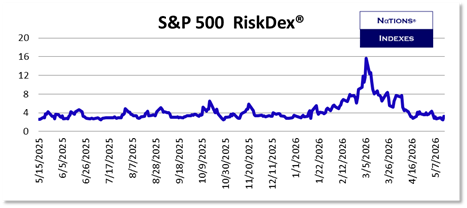
- Every S&P 500 volatility index rose with the exception of 30-Day CallDex which fell by 8.09% for the week as hopes for the recent rally to continue faded. You can learn more about CallDex at Learn More About CallDex;
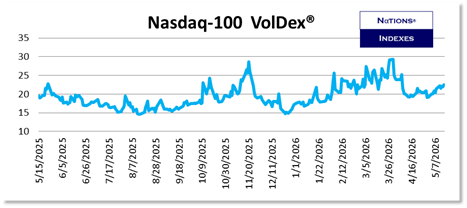
- VolDex on the Nasdaq-100 rose by 5.11% after rising 10.78% in the previous week. It is now at the 54th percentile of its 52-week range;
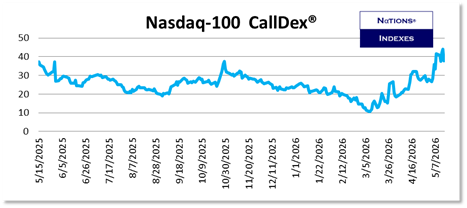
- Nasdaq-100 CallDex fell 8.72% after rising 48.17% in the previous week and making a new 52-week high. This week’s close of 37.94 is the 82nd percentile of its 52-week range and is still signaling substantial bullishness on the part of investors;
- Nasdaq-100 TailDex rose by 9.12% after falling to very cheap levels earlier in the month. Friday’s close of 10.92 is still just the 12th percentile of its 52-week range. You can learn more about TailDex at Learn More About TailDex;
- Volatility in Treasury Bonds spiked this week with every volatility metric gaining and every metric with the exception of 30-Day RiskDex gaining at least 26.00% (30-day RiskDex gained 8.23%). Bond futures fell by 2.64% for the week;
- The individual equities we cover were mixed this week with LLY the big winner, gaining 5.95%, and AMD the big loser, falling 6.83% but the chip maker is still up 108% since the end of March;
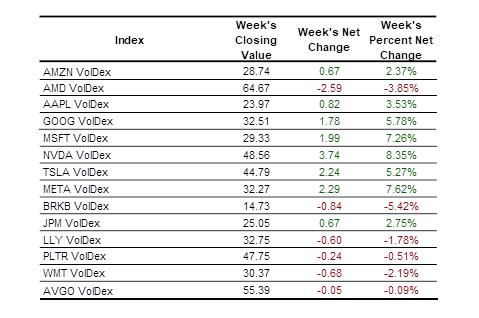
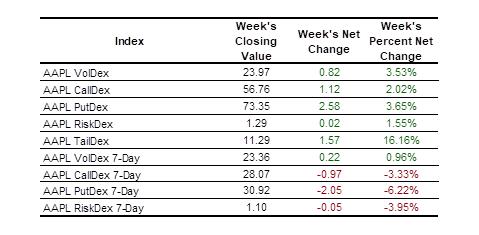
- VolDex on individual stocks showed more green with most tech names seeing higher VolDex values. You can see the week’s results below;
- The Nations Indexes Optimism Index® fell by 2.59% to close at 85.85. Our Optimism Index is always available in real-time on our home page at NationsIndexes.com;
- You can always learn more about all our indexes at Learn More About Our Indexes.
Equity Index Volatility:
The S&P 500 managed to eke out a gain for the week despite Friday’s loss. The index posted a new all-time high of 7517.12 on Thursday. This is the fourth consecutive week the market has posted a new all-time high.
S&P 500 options are telling a more pessimistic story. Every metric except CallDex rose and 7-Day metrics outpaced 30-Day measures. S&P 500 7-Day VolDex rose 22.88%.
S&P 500 VolDex rose slightly last week despite S&P 500 gaining ground. This week repeated that scenario in a signal that traders and investors are a little more dubious about the strength of the rally and are willing to buy relatively inexpensive options for protection.
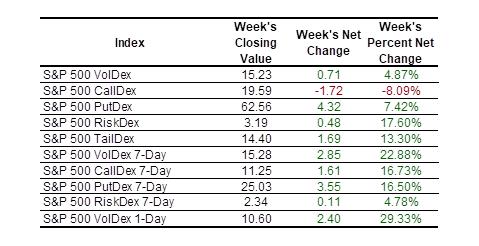
S&P 500 RiskDex jumped on Friday but closed at 3.19 which is just the 5th percentile of its 52-week range and well below the long-term average. This means investors who want to hedge with a collar strategy can do so at attractive levels.
Historical metrics (Average, median, 10th percentile, 25th percentile, 75th percentile, and 90th percentile) for all our indexes are available to subscribers at NationsIndexes.com.
Why It Matters…Historical data for all our indexes is available to subscribers at the Everything! level and they allow option traders to understand the context of the current option pricing environment. You have to understand what normal is in order to do so.
Nasdaq-100 VolDex rose by 5.11% this week after gaining 10.78% in the previous week as traders continue to recognize that options are priced at reasonable levels given the risk and volatility present in tech names.
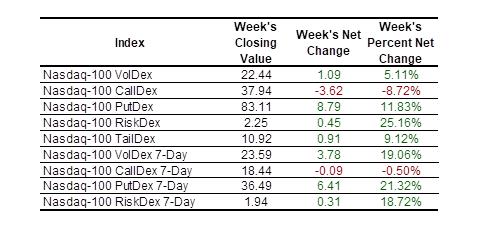
Nasdaq-100 VolDex is at the 54th percentile of its 52-week range (vs. 28th for the S&P and 36th for the Russell 2000) in an expression of the expectation that continued volatility will focus on tech.
You can learn more about VolDex at Learn More About VolDex.
Nasdaq-100 CallDex closed last week at the very top of its 52-week range and fell just 8.72% this week. It remains at the 82nd percentile of its 52-week range so traders have not completely thrown in the towel on the tech rally.
Why It Matters…Traders have to have the objective data provided by our indexes to trade in a way that doesn’t rely on hunches or guesses.
Nations Investor Optimism Index®:
The Investor Optimism Index® fell by 2.59% to close at 85.85 which is still very optimistic for equities over the next 30 days.
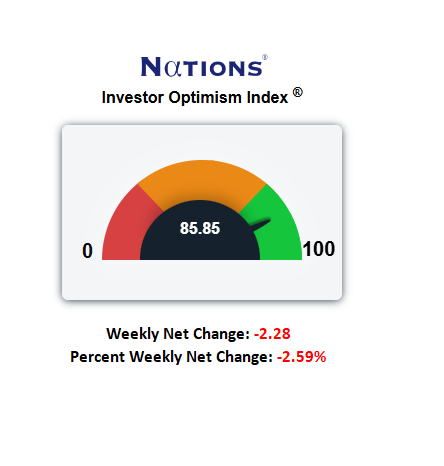
The index takes into account the current levels of S&P 500 VolDex, TailDex, and RiskDex and compares them to their rolling 2-year ranges. It is plotted on a 0 to 100 scale.
Our Optimism Index is now available in real-time on our home page at Nations Optimism Index.
Option Window®:
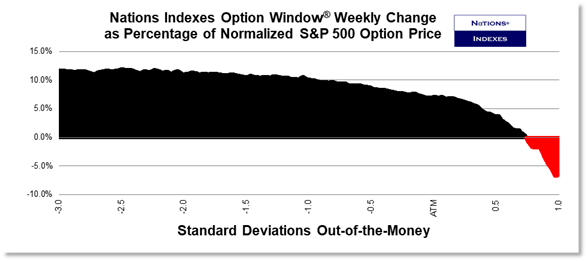
S&P 500 Option Window fills in the blanks between TailDex, PutDex, VolDex, and CallDex and reveals how trade flows were driving option prices. Since Option Window calculates normalized option prices at fixed points of moneyness any changes are driven by option flows rather than movement in the underlying S&P 500.
Option prices gained ground over the bulk of the S&P 500 option skew as traders recognize that the spike in interest rates and continued uncertainty in the Persian Gulf are hurdles the market will have to clear if it is to continue its rally. Sellers were in charge only in out-of-the-money call options as traders sold those as covered calls or to get short exposure.
Term Structure:
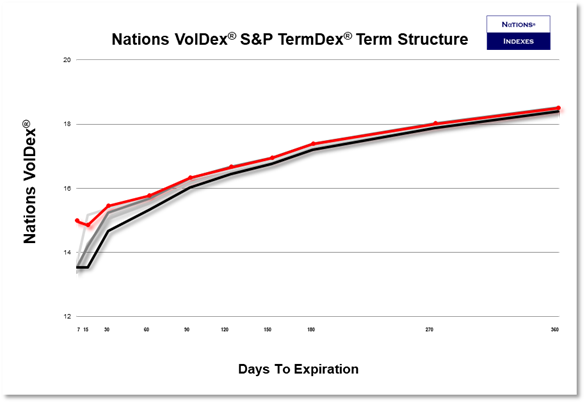
The Nations TermDex® measure of VolDex term structure illustrates S&P 500 VolDex for various tenors. It provides insight into both near-term and longer-term expectations for volatility in the S&P 500.
Term structure at the close on Friday (in red) remains upward-sloping from left to right although the kink in the 7-Day tenor tells us traders are worried about follow through from Friday’s break.
1DTE Options:
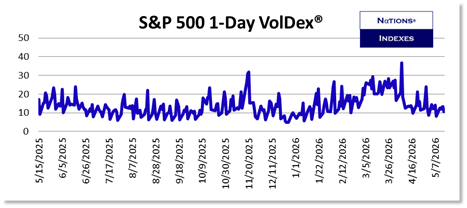
S&P 500 1-Day VolDex rallied 29.33% and is back above 10.00.
Very short-dated volatility measures which use a variance swap methodology, as 1-day VIX does, inject significant error into the resulting measure because of the way out-of-the-money options trade in the hours before expiration. The VolDex at-the-money methodology is particularly suited for these very short-dated tenors.
Other Asset Volatility:
Treasury Bonds and Notes:
While Tuesday’s CPI release showed consumer inflation in April matched consensus estimates, the headline number was a monthly increase of 0.6%. Wednesday’s PPI data was even worse with producer inflation increasing by 1.4% in April versus expectations of just 0.5%. Bond futures resumed their decline and lost more than 3 points on the week. The 30-year treasury yield topped 5.00% and this will be a problem for stocks and the economy in general.
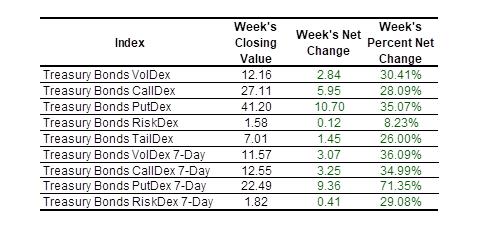
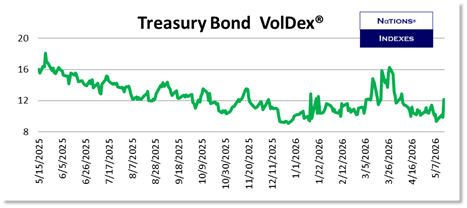
Treasury Bond option prices rose in response as you can see. Last week we pointed out that “Any directional speculation in Treasury Bonds should be expressed using at-the-money options.” That certainly worked out. Treasury Bond VolDex gained 30.41% for the week but the close of 12.16 is still just the 34th percentile of its 52-week range meaing directional speculation or positioning should still be expressed using at-the-money options.
Precious Metals:
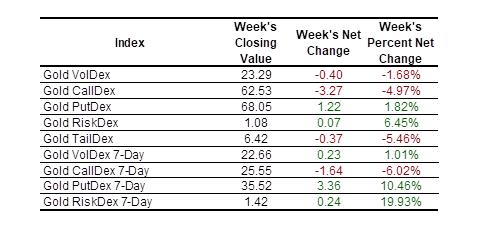
Gold fell 3.81% for the week and lost ground every day but Monday. Silver lost 5.63% for the week due to a loss of 9.02% on Friday.
Equities:
We have expanded the list of single names we cover to include not only the most dynamic stocks in the S&P 500 and the stocks with the highest option volume, but also the largest names in the S&P 500.
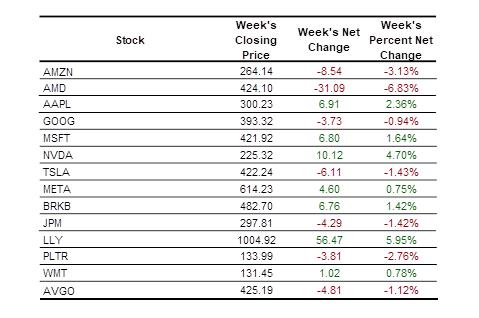
AMD was the big loser on the week but, as mentioned above, it declined from a very elevated level.
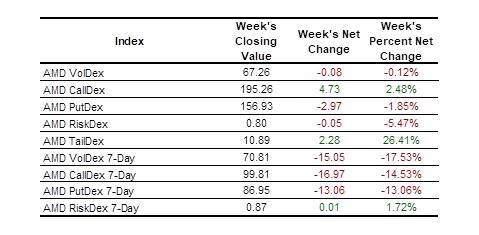
AMD volatility was generally lower this week as the volatility crush from the previous week’s earnings report finally managed to overcome the furious rally in the share price and resulting strength in volatility.
AAPL managed to gain 2.36% for the week and closed at 300.23. But those shares are now overbought with an RSI of 75.66. All 30-Day volatility metrics gained for the week so while investors drove shares higher into overbought territory, traders were buying volatility in AAPL.
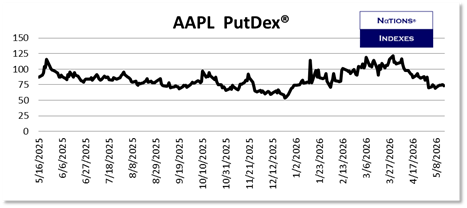
AAPL PutDex closed at 73.35 which is just the 29th percentile of its 52-week range for traders who believe AAPL’s overbought situation will resolve with the shares falling.
You can learn more about PutDex at Learn More About PutDex.
We’ll continue to comment during the week via our X account, @Nations_Indexes.
Scott's Weekly Commentary:
Last week I wrote about the fact that our national debt is now larger than our entire economy as measured by annual GDP. So as if on cue, the yield on 30-Year Treasury Bonds topped 5% this week. We saw this level in May of 2025 and October of 2023 buy you have to go back more than 20 years to find the time when rates were substantially higher than they are now.
But rather than just complain about the weather, what can we do about it? First, I don’t think rates are going to come back down. Inflation is real and it’s fueled by, well, fuel prices. So unless the war with Iran ends very soon and the Strait of Hormuz is reopened within 30 days, crude oil will remain above $90 a barrel.
Additionally, our government is now borrowing so much money, about $158 billion each month, that it is pushing rates higher.
This will hurt growth stocks in particular because their future earnings are worth less now than they were when rates were lower. Private credit is going to get killed. I mean, it’s nearly dead now but look out for whatever is left. Bonds are obviously in trouble and precious metals, which don’t pay a dividend but instead have to be stored and insured, will weaken.
What sectors might benefit? Banks will benefit if the increase in rates is modest as their margins will improve. But who knows if things really get out of hand and borrowers start to default.
I hope you have a safe and profitable week.
Scott
