The Weekly Takeaway:
- The S&P 500 gained 3.56% this week thanks to a 2.51% rally on Wednesday. The index is now down just 0.42% for the year;
- The Nasdaq-100 gained 4.45% this week and closed higher each day. It is now down just 0.53% for the year;
- Crude oil futures fell 14.05% to close at $95.87;
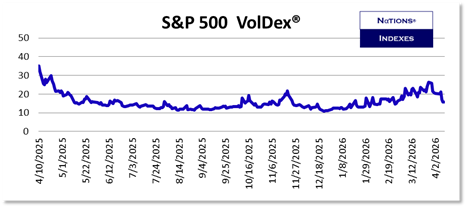
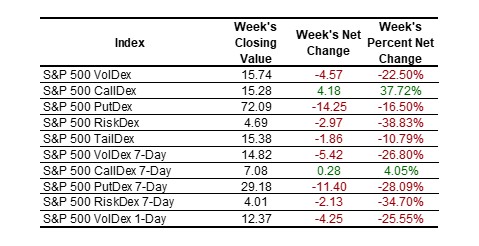
- S&P 500 VolDex (ticker VOLI) fell 22.50% to close at 15.74;
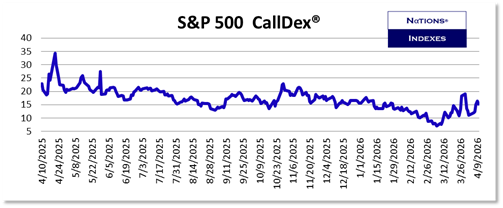
- S&P 500 CallDex rose 37.72% as traders reached to buy upside exposure. You can learn more about CallDex at Learn More About CallDex;
- Every 30-Day volatility metric for the S&P 500 was lower on the week with the exception of 30-Day and 7-Day CallDex which both rose thanks to renewed enthusiasm for stocks in the face of the ceasefire in Iran;
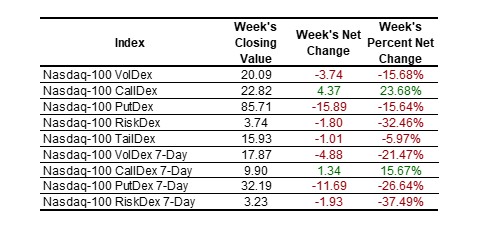
- VolDex on the Nasdaq-100 fell by 15.68% to close at 20.09;
- Nasdaq-100 30-Day volatility metrics echoed those for the S&P 500 in that they all fell with the exceptions of both tenors in CallDex;
- Nasdaq-100 TailDex fell just 5.97% suggesting investors are optimistic but realize the market is vulnerable to a single social media post. You can learn more about TailDex at Learn More About TailDex;
- The yield on Treasury Notes increased just 4/10ths of a basis point this week and closed at 4.317%;
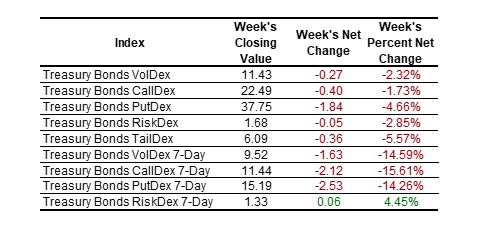
- Every 30-Day volatility metric for Treasury Bonds fell this week as the ceasefire in Iran and the potential for it to hold suggests bond and note prices will be less volatile over the next 30 days;
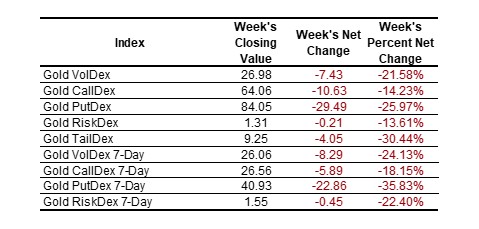
- Gold gained 1.63% for the week despite Friday’s news that CPI rose 3.3% over the past 12 months. Every volatility metric in gold fell considerably. Gold VolDex fell by 21.58%;
- The individual equities we cover were generally higher this week with only MSFT (-0.69%), TSLA (-3.23%), and PLTR (-13.74%) falling;
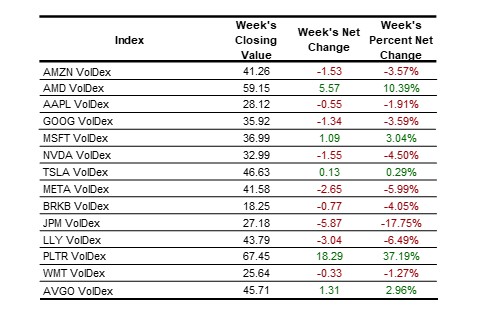
- VolDex on the individual names was more mixed as the heart of earnings season approaches:
- The Nations Indexes Optimism Index® rose by 20.59% to close at 79.29. Our Optimism Index is always available in real-time on our home page at NationsIndexes.com;
- You can always learn more about all our indexes at Learn More About Our Indexes.
Equity Index Volatility:
The S&P 500 gained 3.56% this week thanks largely to a gain of 2.51% on Wednesday as tensions with Iran cooled. The S&P was able to look past Friday’s inflation data although it means the likelihood of Fed rate cuts continue to fade. The market now believes the odds of 1 or more rate cuts by the end of the year are 27%. A month ago those odds were 76%.
The price of crude oil and its impact on inflation will remain a problem for our stock market.
S&P 500 CallDex has been particularly volatile this year and this week was no exception. Low call prices offer the opportunity for levered bets for bulls while high call prices offer an opportunity to sell covered calls. CallDex measures the normalized price of the 30-Day, 1 standard deviation out-of-the-money call option; that corresponds to a 16 delta call.
RiskDex fell by 38.83% this week but it is falling from unprecedented levels and it is still well above long-term averages. The average close for S&P 500 RiskDex since inception (1/31/2005) is 3.77 and the median close is 3.43 so the current level of 4.69 remains elevated and signals worry on the part of investors.
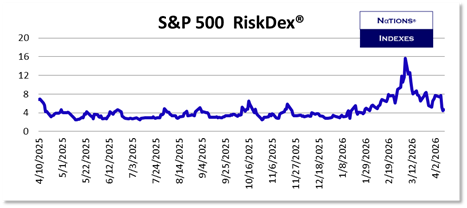
Historical metrics (Average, median, 10th percentile, 25th percentile, 75th percentile, and 90th percentile) for all our indexes are available to subscribers at NationsIndexes.com.
Why It Matters…Historical data for all our indexes is available to subscribers at the Everything! level and they allow option traders to understand the context of the current option pricing environment. You have to understand what normal is in order to do so.
Nasdaq-100 VolDex fell by 15.68% and Nasdaq-100 CallDex rose by 23.68%.
Nasdaq-100 VolDex is at the 22nd percentile of its 52-week range but these percentile values will worsen over the next month as the high levels reached in April 2025 roll off.
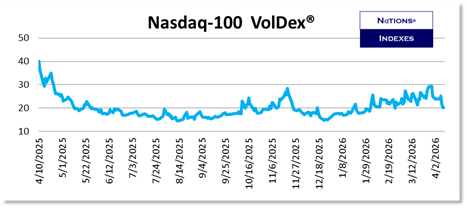
You can learn more about VolDex at Learn More About VolDex.
Nasdaq-100 RiskDex fell by 32.46%, mimicking the move in the S&P.
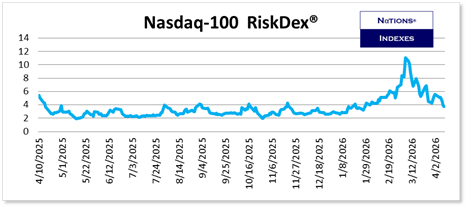
Why It Matters…Traders have to have the objective data provided by our indexes to trade in a way that doesn’t rely on hunches or guesses.
Nations Investor Optimism Index®:
The Investor Optimism Index® rose by 20.59% to close at 79.29.
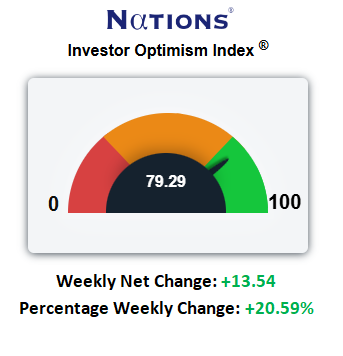
The index takes into account the current levels of S&P 500 VolDex, TailDex, and RiskDex and compares them to their rolling 2-year ranges. It is plotted on a 0 to 100 scale.
Our Optimism Index is now available in real-time on our home page at Nations Optimism Index.
Option Window®:
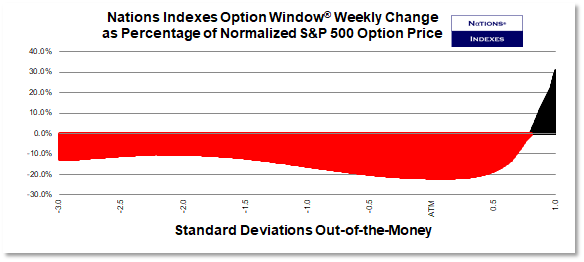
Option Window fills in the blanks between TailDex, PutDex, VolDex, and CallDex and reveals how trade flows were driving option prices.
Option prices were lower across most of the skew with the highest conviction selling taking place near at-the-money. Option prices were higher only in strike prices above 0.75 standard deviations above at-the-money (approximately 7035).
Term Structure:
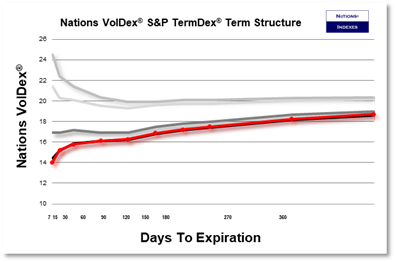
The Nations TermDex® measure of VolDex term structure illustrates S&P 500 VolDex for various tenors. It provides insight into both near-term and longer-term expectations for volatility in the S&P 500.
Term structure normalized considerably this week, going from inverted (upper left to lower right) to the normal upward sloping shape.
1DTE Options:
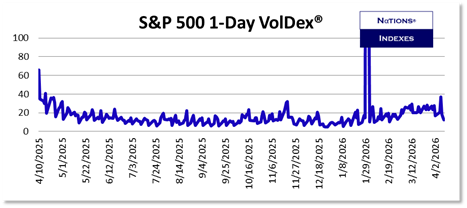
S&P 500 1-Day VolDex fell by 25.55% to close at 12.37.
Very short-dated volatility measures which use a variance swap methodology, as 1-day VIX does, inject significant error into the resulting measure because of the way out-of-the-money options trade in the hours before expiration. The VolDex at-the-money methodology is particularly suited for these very short-dated tenors.
Other Asset Volatility:
Treasury Bonds and Notes:
Bond futures have dropped in price by 4.08% since the war began. However, nearly every Treasury Bond volatility metric fell on the week thanks to the ceasefire.
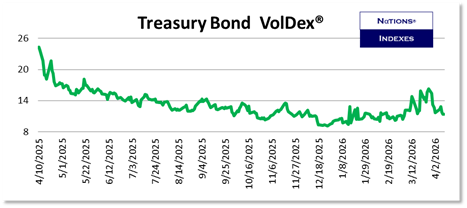
Treasury Bond VolDex managed to shake off the disappointing inflation data.
Precious Metals:
Precious metals gained on the week with gold climbing 1.63%. Every volatility metric for gold fell at least 13% this week and the recent volatility, first up then down, abates.
Equities:
We have expanded the list of single names we cover to include not only the most dynamic stocks in the S&P 500 and the stocks with the highest option volume, but also the largest names in the S&P 500.
Many of the names we cover had a very good week with AMZN, AMD, and AVGO all gaining more than 10%. PLTR was the big loser, falling 13.74%, on concerns that it is falling behind Anthropic.
TSLA continues to disappoint as sky-high valuations and cooling new EV sales (sales of used EVs have been strong as gas prices spike) continue to hurt the stock.
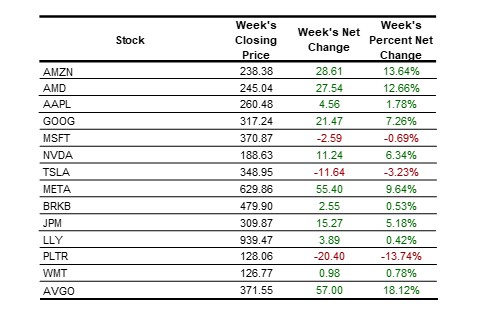
VolDex was mixed for the single names this week.
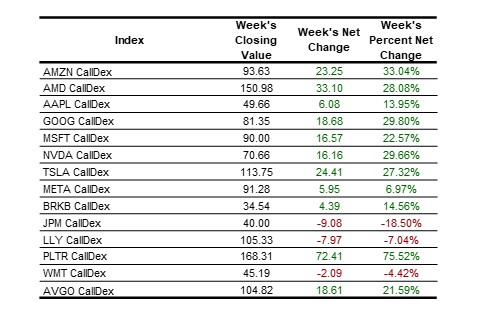
CallDex was particularly strong for the equities we cover as traders reached for out-of-the-money calls to get upside exposure.
TailDex was also interesting for the equities. It was lower for every name with the exception of AMZN (up just 0.55%). This is in contrast to the smaller decrease in TailDex on the S&P 500 and Nasdaq-100. TailDex values for AMZN, MSFT, NVDA, and AVGO are all below the 10th percentile of their 52-week ranges.
You can learn more about TailDex at Learn More About TailDex.
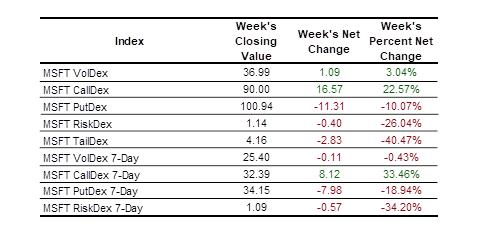
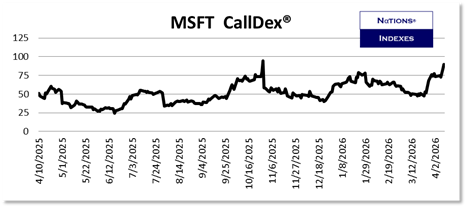
The volatility regime is striking in MSFT and offers several interesting trades. Shares had a wild ride, bottoming at 344.79 in April 2025 before gaining 61.1% (555.45) by July and then rolling over and falling back to 356.51 during the last half of March 2026. Despite making a round trip, traders now believe MSFT has bottomed and volatility metrics are optimistic with CallDex at the 93rd percentile of its 52-week range.
We’ll continue to comment during the week via our X account, @Nations_Indexes.
Scott's Weekly Commentary:
Tuesday’s news of a ceasefire was a relief from the administration’s belligerent rhetoric which threatened to bomb Iran back “into the stone ages”. The ceasefire was welcomed by the stock market and with good reason – crude oil fell 14.47% that day. However, crude is still up 42% since the whole thing started so the end result is Iran gets to sell its oil to China at a 42% markup, gasoline prices here are up 37% since the end of February, and Iran is going to charge a toll to every ship passing through the Strait of Hormuz. None of this is good for our stock market.
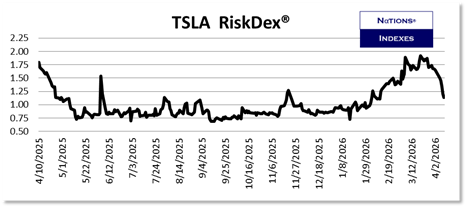
I wrote about TSLA for CNBC.com on March 25 (You can read it here but it may be behind the CNBC.com Pro paywall), pointing out that TSLA RiskDex was bearish. Combined with a forward PE of 175 and declining new EV sales due to the expiration of the tax credit, I said TSLA would have a tough 30 days. You would have thought I insulted someone’s mother based on the comments readers left on the site and the comments I got on X.
I think Elon Musk is unique in the American stock market, with the possible exception of Warren Buffett, and that has helped TSLA. Elon is iconoclastic and beloved by millions of investors. Those investors have bought TSLA shares at nearly every opportunity, driving the company’s market cap on the day I published that article to be equal to the sum of all other publicly traded automobile makers combined.
Buying shares because a founder is charismatic is not new; I can remember it happening with AAPL and Steve Jobs. But it’s a fraught strategy, particularly when the shares are trading at a 175 forward PE. RiskDex was right once again; since the close on the day my article appeared TSLA has dropped 9.59% while the S&P has gained 3.41%. I write about the phenomena of the “cult of personality” in The Anxious Investor where I borrow the term “Phantastic Objects” (sic) from the academic research into the topic.
Traders and investors need a healthy dose of steely-eyed discipline. Even more so when facing a charismatic iconoclast who we find appealing. Because no matter how many Teslas you buy, nor how many shares you accumulate, you and Elon aren’t friends and he isn’t going to invite you over to his house to have a beer and watch the ball game.
TSLA RiskDex has eased since then, as you can see below, as some investors take advantage of lower prices. It will be interesting to watch.
Everyone at Nations Indexes hopes you have a profitable week and that all American service members have a safe one.
Scott