The Weekly Takeaway:
- The S&P 500 lost 1.90% this week. That is the fourth straight weekly loss for the S&P 500 and it is now down 4.95% for the year;
- The Nasdaq-100 lost 1.98% this week. It is down 5.35% for the year;
- Crude oil futures fell 1.23% to close at $98.09;
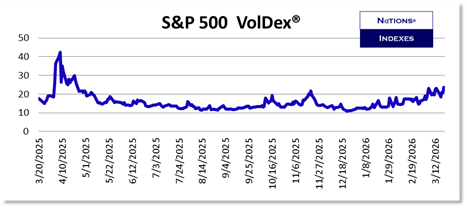
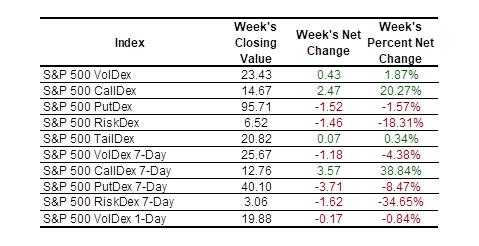
- S&P 500 VolDex (ticker VOLI) rose 1.87% to close at 23.43;
- S&P 500 CallDex rose 20.07% this week to close at 14.67 but this is a function of traders reaching to buy implied volatility rather than bullish sentiment;
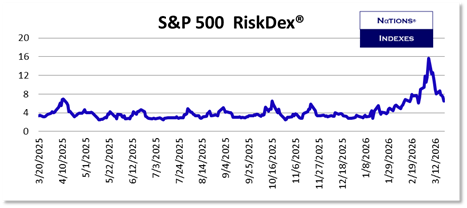
- S&P 500 RiskDex fell another 18.31% this week but it is still elevated and this week’s move was a result of the increase in CallDex rather than a decrease in fear;
- You can learn more about RiskDex at Learn More About RiskDex;
- Our put metrics for the S&P 500, 30-Day PutDex and TailDex, were little changed this week. This signals that hedgers believe out-of-the-money puts are fairly priced even if those prices are elevated;
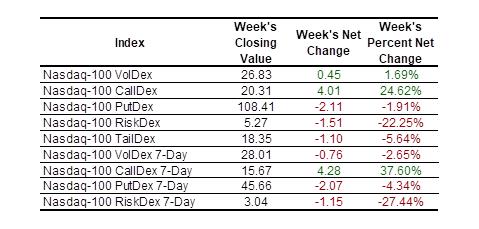
- VolDex on the Nasdaq-100 rose by 1.69% to close at 26.83;
- Nasdaq-100 volatility metrics echoed those for the S&P 500 in that CallDex rose substantially causing RiskDex to fall;
- The yield on Treasury Notes rose another 10.6 basis points this week after rising 15.2 basis points and 17.1 basis points in the previous two weeks. It closed on Friday at 4.391%. That is the highest level since August;
- Every 30-day volatility metric for Treasury Bonds with the exception of TailDex rose on the week. Options continue to signal a bearish outlook for Treasury Bonds;
- Gold lost 10.28% for the week thanks to losses of at least 3.34% on Wednesday, Thursday, and Friday. Silver lost 15.21% on the week;
- Bitcoin futures fell by 1.60% for the week but managed to stay above $70,000 and closed at $70,320;
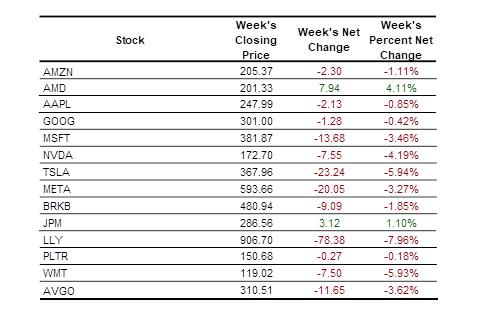
- The individual equities we cover were all lower this week with the exceptions of AMD (+4.11%) and JPM (+1.10%). LLY, TSLA, and WMT all fell by more than 5.00%;
- Interestingly, VolDex on the single names we cover was mostly lower as the extreme fear of the previous weeks ebbed;
- The Nations Indexes Optimism Index® rose by 5.25% to close at 61.98. Optimism rose because RiskDex fell by 18.31% albeit from a very elevated level. Our Optimism Index is always available in real-time on our home page at NationsIndexes.com;
- You can always learn more about all our indexes at Learn More About Our Indexes.
Equity Index Volatility:
The S&P 500 lost another 1.90% for the week and fell on each of the last three days of the week.
Geopolitical concerns continued to weigh on stocks although Wednesday’s report that producer prices rose by 0.7% during February (the market was expecting an increase of just 0.3%) fueled interest rate fears and squelched hopes that the Federal Reserve was going to cut short-term interest rates at its April meeting. One month ago the market was saying the odds of the Fed holding rates steady at its April meeting were 83% while the odds of a rate cut were 17%. As of Friday’s close the market was saying the odds of holding steady were 94% but the odds of a rate cut were zero and the odds of a rate hike were 6%. The fact that the S&P 500 fell on each day after the release of that producer price data is a sign of how stocks view higher interest rates.
Don’t be fooled by the rally in S&P 500 CallDex. It is a function of traders buying implied volatility delta-neutral in the cheapest strikes possible – in the equity index world those are almost always the out-of-the-money calls – rather than bullishness.
S&P 500 RiskDex fell by another 18.31% but it is still at an elevated level and this week’s action is due to traders buying volatility via calls (rather than buying them because they’re bullish) which is not a positive for the S&P 500. The average close for S&P 500 RiskDex since inception (1/31/2005) is 3.77 and the median close is 3.43 so current levels remain elevated and pessimistic.
Historical metrics (Average, median, 10th percentile, 25th percentile, 75th percentile, and 90th percentile) for all our indexes are available to subscribers at NationsIndexes.com.
Why It Matters…Historical data for all our indexes is available to subscribers at the Everything! level and they allow option traders to understand the context of the current option pricing environment. You have to understand what normal is in order to do so.
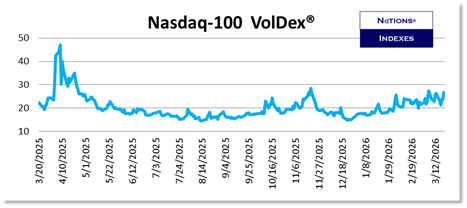
Nasdaq-100 VolDex rose by 1.69%.
Nasdaq-100 VolDex is at the 38th percentile of its 52-week range.
Why It Matters…Traders have to have the objective data provided by our indexes to trade in a way that doesn’t rely on hunches or guesses.
Nations Investor Optimism Index®:
The Investor Optimism Index® rose by 5.25% to close at 61.98.
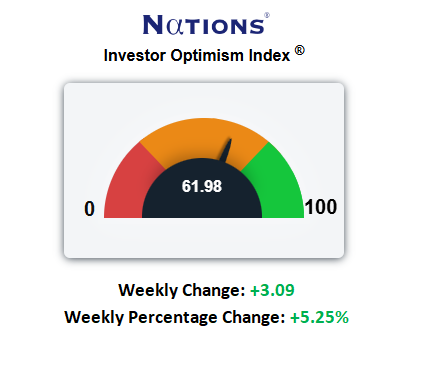
The index takes into account the current levels of S&P 500 VolDex, TailDex, and RiskDex and compares them to their rolling 2-year ranges. It is plotted on a 0 to 100 scale.
Our Optimism Index is now available in real-time on our home page at Nations Optimism Index.
Option Window®:
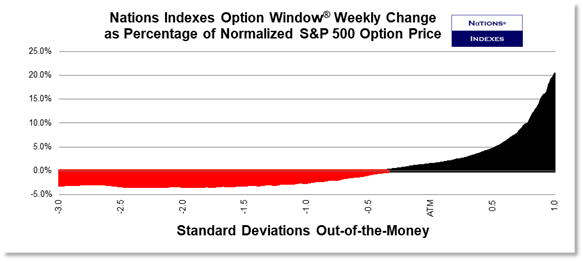
Option Window fills in the blanks between TailDex, PutDex, VolDex, and CallDex and reveals how trade flows were driving option prices.
Option prices were largely unchanged across most of the skew with put prices slightly lower. But out-of-the-money call prices surged as discussed above. Don’t be fooled into thinking this is a sign of bullishness.
Term Structure:
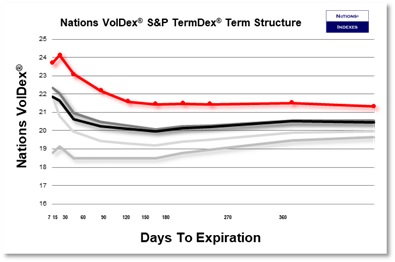
The Nations TermDex® measure of VolDex term structure illustrates S&P 500 VolDex for various tenors. It provides insight into both near-term and longer-term expectations for volatility in the S&P 500.
Friday’s closing term structure, in red (other days of the week are in black and gray), was steeply inverted. This is a signal that traders are worried about volatility in the short term. There is a kink at the 15-day tenor because that’s the first tenor that catches the next jobs report which could be critical for stocks.
1DTE Options:
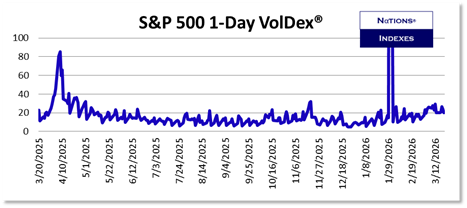
S&P 500 1-Day VolDex fell by 0.84% but remains elevated at 19.88. The relatively small move suggests traders believe very short-dated options are priced fairly because they expect volatility to remain higher than normal. A reading of 19.88 says traders expect a move of at least 1.24% over the next trading day.
Very short-dated volatility measures which use a variance swap methodology, as 1-day VIX does, inject significant error into the resulting measure because of the way out-of-the-money options trade in the hours before expiration. The VolDex at-the-money methodology is particularly suited for these very short-dated tenors.
Other Asset Volatility:
Treasury Bonds and Notes:
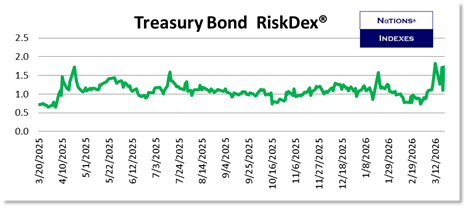
Bond futures have dropped 5.05% since the war began and Treasury Bond volatility metrics continue to rally. Last week we pointed out, “This price action in Treasury Bond options signals a very bearish outlook on the part of traders” and that proved to be the case with Treasury Bond futures falling by more than 1 point in price or 0.96% on the week.
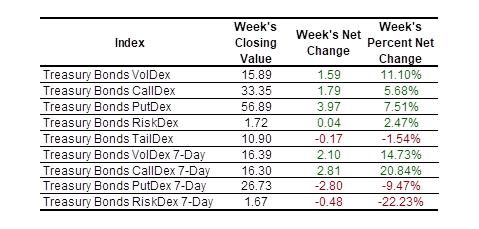
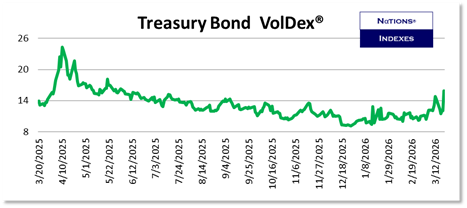
Treasury Bond VolDex closed at the 45th percentile of its 52-week range.
Treasury Bond RiskDex is now at the 92nd percentile of its 52-week range signaling substantial fear among Treasury Bond holders.
Precious Metals:
Precious metals got clobbered this week as recent euphoria continues to fade and as holders recognize gold is less attractive when interest rates are increasing as they are now.
Every volatility metric in gold rose on the week with the exception of 30-Day CallDex which fell by 3.36% as gold bulls threw in the towel.
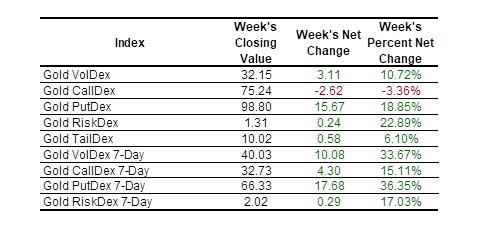
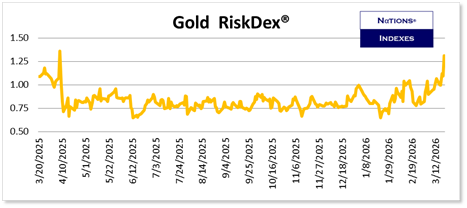
Gold has traditionally displayed call skew meaning out-of-the-money calls are more expensive than out-of-the-money puts. This means RiskDex is traditionally below 1.00. So the recent action in Gold RiskDex is telling as it has rallied, gaining another 22.89% this week, and closed at 1.31. This means PutDex is higher than CallDex and out-of-the-money puts are more expensive than out-of-the-money calls. This signals bearishness on the part of gold traders. Gold RiskDex closed at the 93rd percentile of its 52-week range.
Equities:
We have expanded the list of single names we cover to include not only the most dynamic stocks in the S&P 500 and the stocks with the highest option volume, but also the largest names in the S&P 500.
Most of the names we cover once again fell along with the broad market.
VolDex trended lower for most names as the month’s highest levels of apprehension eased and as traders came to believe options, while expensive, are fairly priced.
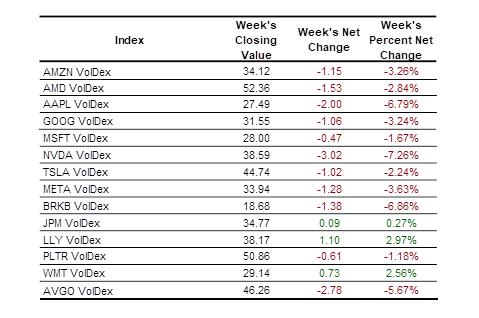
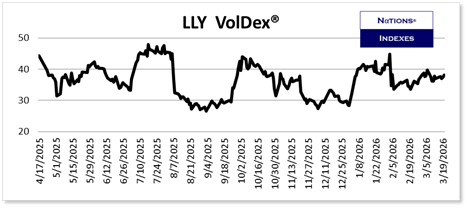
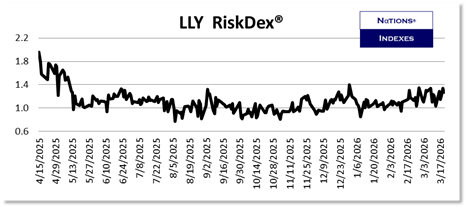
RiskDex was mixed in the single names although it is above 1.60 for every name except LLY. While RiskDex in LLY is at just 1.27, it rallied by 23.03% this week as the shares fell 7.96% and retreated from their spectacular run in the last half of 2025 (+81.79% from August 7 to January 8). The decline was due to valuations and concerns about pricing pressure for the company’s GLP-1 offerings which generate more than 50% of the company’s revenues.
LLY VolDex displays considerable seasonality due to earnings.
LLY RiskDex is interesting because it has frequently displayed call skew over the last 12 months due again to the prospects for its GLP-1 drugs and the performance of the shares. It closed this week at 1.27 but the chart suggests it has difficulty getting above 1.40. If it reaches that level it will be interesting for LLY bulls who are not worried about GLP-1 pricing power to investigate put spread risk reversals (selling a put spread and using the proceeds to buy a call option).
You can learn more about RiskDex here.
All our index values are available in real-time to subscribers.
We’ll continue to comment during the week via our X account, @Nations_Indexes.
Scott's Weekly Commentary:
This market remains subject to the latest news item and while we’re all watching the news from the Middle East, the stock market was focused on Wednesday morning’s inflation data. PPI was much higher than expected and it was no accident that the S&P dropped on each of the last three days of the week in response. Stocks hate higher interest rates because they make companies less profitable while at the same time making fixed income investments more competitive.
I’ve been saying for some time that our economy is not calling for the Fed to cut rates. With inflation well above the Fed’s 2% target, even before the latest PPI data, and unemployment well below that 5% target, I’ve been saying on “X” for months that a rate hike was more appropriate than an inflation-fueling rate cut. I think the market is coming around to my thinking and it won’t be good for stocks.
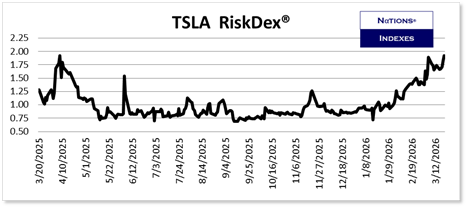
I’ll be watching TSLA RiskDex as it evolves from being consistently below 1.00, signaling call skew and bullishness, to being consistently above 1.00 signaling that the euphoria regarding Elon has faded and the company will have to perform on the bottom line without being given the benefit of the doubt. With a forward PE of 175 there is no room for error here and investors should remember that the federal tax credit for EVs expired last September. This will be a fun one to watch and opportunities will abound for both bulls and bears.
Everyone at Nations Indexes hopes you have a profitable week and that all American service members have a safe one.
Scott