
The Weekly Takeaway:
- The S&P 500 gained 1.07% this week. It is now up 0.94% for the year;
- The Nasdaq-100 gained 1.13% this week. It is now down 0.94% for the year;
- Stocks performed well despite weaker than expected Q4 GDP data (1.4% vs. expectations of 2.9%) and hotter than expected inflation data (PCE of 0.4% vs. expectations of 0.3%) as investors held onto hope for rate cuts from the Fed later this year;
- S&P 500 VolDex (ticker VOLI) fell by 6.49% this week and closed at 15.85. Friday’s close is the 17th percentile of the 52-week range;
- S&P 500 TailDex (ticker TDEX) rose by 2.29% after rising 24.79% during the previous week and closed at 18.28. That is the 25th percentile of its 52-week range;
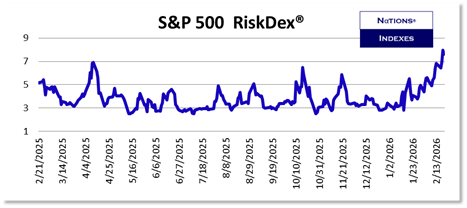
- S&P 500 RiskDex rose by 11.55% to close the week at 7.63. That is the 94th percentile of its 52-week range and describes very strong conviction among traders that the S&P 500 is more likely to fall than rally over the next 30 days. You can learn more about RiskDex at Learn More About RiskDex;
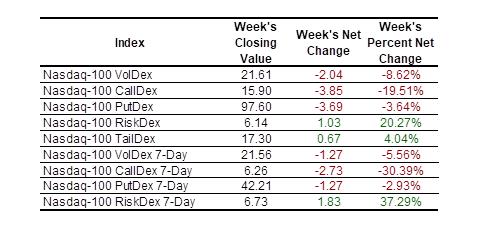
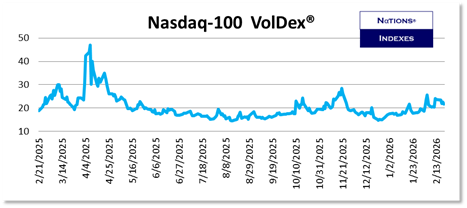
- VolDex on the Nasdaq-100 fell by 8.62% to close at 21.62;
- RiskDex on the Nasdaq-100 rose by 20.27% to close at 6.14. That is a 52-week closing high and the highest level in more than 4 years;
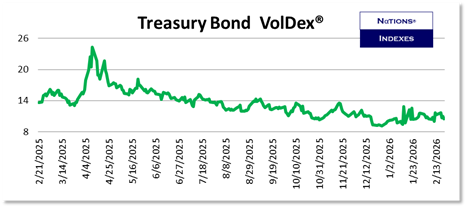
- The yield on Treasury Notes rose by 3 basis points to close at 4.036% as Treasury notes fell in price by 0.23%. Treasury Bond VolDex fell by 6.98% to close at 10.49;
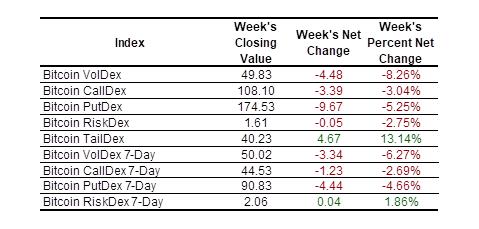
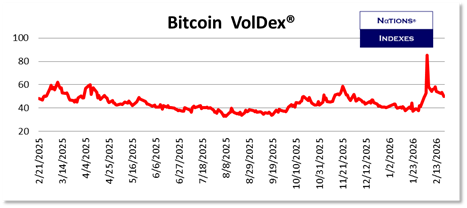
- Bitcoin futures lost another 1.84% this week. Bitcoin volatility continued to ease after its explosive rally 2 weeks ago. Bitcoin VolDex closed at 49.83, a decline of 8.26%;
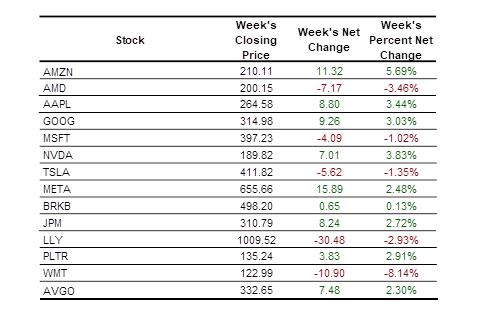
- The individual equities we cover were mixed this week with AMZN leading the way higher (+5.69%) and WMT leading the losers (-8.14%) as strong earnings weren’t enough to offset a weaker than expected outlook for the remainder of the year for the retailer;
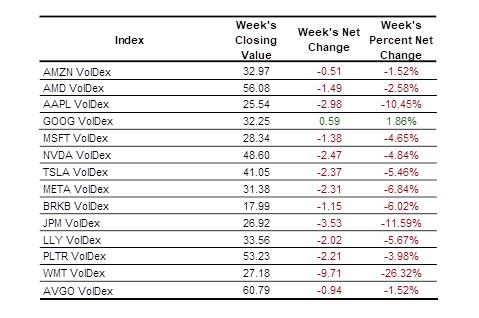
- VolDex on the single names we cover was lower across the board with the exception of GOOG (+1.86%) as fears for tech and AI eased and as WMT experienced the typical post-earnings volatility crush;
- The Nations Indexes Optimism Index® fell by 4.56% to close at 55.43 despite the rally in the S&P 500. Optimism fell due to increases in both RiskDex and TailDex. Our Optimism Index is always available in real-time on our home page at NationsIndexes.com;
- You can always learn more about all our indexes at Learn More About Our Indexes.
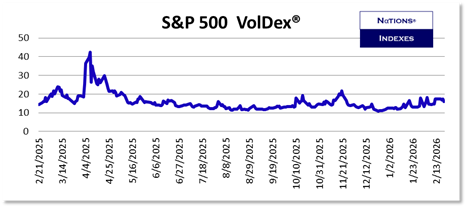
Equity Index Volatility:
The S&P 500 gained on the week thanks to strong performances on Wednesday (+0.56%) and Friday (+0.69%). Much of Friday’s rally came after the Supreme Court struck down the administration’s import tariffs despite the later announcement of a new across-the-board 10% global tariff.
VolDex and CallDex on the S&P 500 fell with CallDex falling 13.03% to close at just 10.17. CallDex is at the absolute bottom of its 52-week range signaling very little optimism regarding the prospects for a rally in the S&P 500 over the next 30 days. 7-Day CallDex fell by 29.77%.
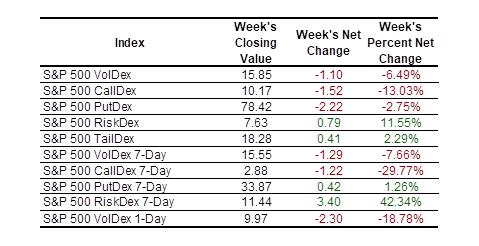
S&P 500 RiskDex gained 11.55% after gaining 29.08% in the previous week. This level for RiskDex says traders believe the likelihood of a decline in the S&P 500 is MUCH greater than the likelihood of a rally. However, when RiskDex is moderately elevated the S&P 500 tends to do well over the next 30 calendar days (21 trading days) as you can see.
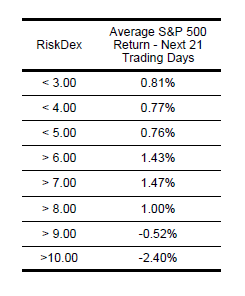
But when RiskDex reaches extreme levels then the S&P tends to fall. The current level of RiskDex is nonetheless worrying because it indicates traders are in the mood to sell stocks but higher levels mean they are actually selling stocks.
Historical metrics (Average, median, 10th percentile, 25th percentile, 75th percentile, and 90th percentile) for all out indexes are available to subscribers at NationsIndexes.com.
Why It Matters…Historical data for all our indexes is available to subscribers at the Everything! level and they allow option traders to understand the context of the current option pricing environment – the current environment, while not unique, is unusual. Volatility is mean-reverting and that is a phenomenon traders can take advantage of in both directions. But you have to understand what normal is, what the “mean” is, in order to do so.
Nasdaq-100 VolDex fell by 8.62% this week while CallDex fell 19.51% echoing the action in the S&P 500.
Nasdaq-100 VolDex is still at just the 28th percentile of its 52-week range.
Nasdaq-100 RiskDex rallied 20.27% and closed at the high of its 52-week range.
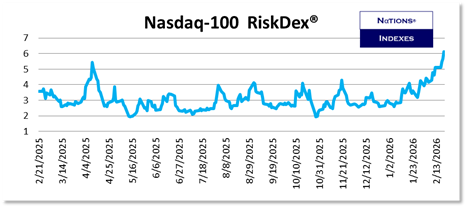
As we pointed out last week, “While RiskDex in both the S&P 500 and Nasdaq-100 are very high, signaling that traders believe there is much more likelihood of a decline than a rally over the next 30 days, absolute measures like VolDex and PutDex in both the S&P 500 and Nasdaq-100 are expensive but not egregiously so.”
That meant the S&P 500 and Nasdaq-100 were both able to rally this week but this week’s rally, and subsequent rallies, are likely to be subdued as long as concern, as expressed by RiskDex, remains high.
You can learn more about VolDex at Learn More About RiskDex.
Why It Matters…Traders have to have the objective data provided by our indexes to trade in a way that doesn’t rely on hunches or guesses.
Nations Investor Optimism Index®:
The Investor Optimism Index® fell by 4.56% to close at 55.43. It fell despite the rally in the S&P 500 due to gains in both RiskDex and TailDex.
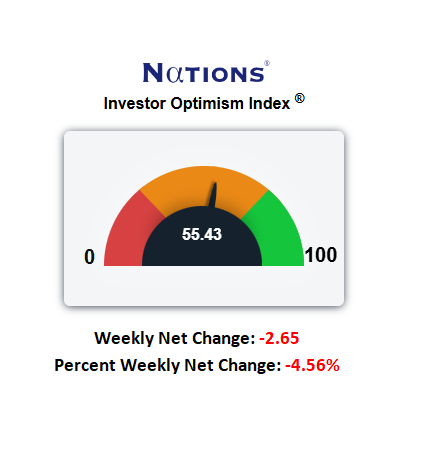
The index takes into account the current levels of S&P 500 VolDex, TailDex, and RiskDex and compares them to their rolling 2-year ranges. It is plotted on a 0 to 100 scale.
Our Optimism Index is now available in real-time on our home page at Nations Optimism Index.
Term Structure:
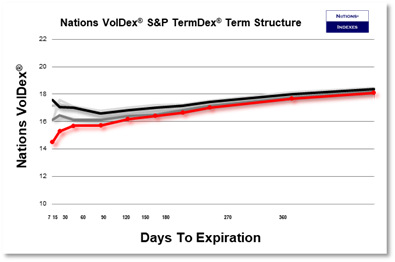
The Nations TermDex® measure of VolDex term structure illustrates S&P 500 VolDex for various tenors. It provides insight into both near-term and longer-term expectations for volatility in the S&P 500.
Friday’s closing term structure, in red, returned to a more normal shape and slope from flatter term structures earlier in the week.
1DTE Options:
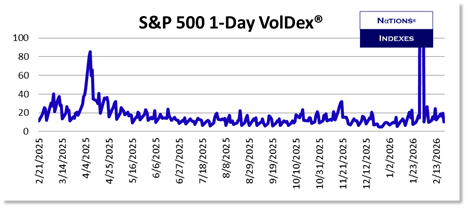
S&P 500 1-Day VolDex fell by 18.78% to close at just 9.97.
Very short-dated volatility measures which use a variance swap methodology, as 1-day VIX does, inject significant error into the resulting measure because of the way out-of-the-money options trade in the hours before expiration. The VolDex at-the-money methodology is particularly suited for these very short-dated tenors.
Other Asset Volatility:
Treasury Bonds and Notes:
Treasury Bond volatility metrics displayed a distinct directional bias this week with CallDex falling by 14.34% while PutDex gained 5.97% and TailDex gained 32.52%.
Clearly traders were positioning themselves for downside in Treasury Bond prices. Some of this is due to unwinding of bullish option positioning from the previous week but that cannot account for all of this week’s bearish option flow.
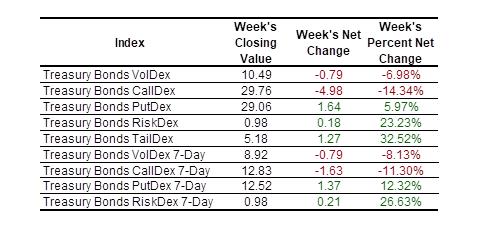
Treasury Bond VolDex closed at the 9th percentile of its 52-week range and any dip below 10.00 should be considered an opportunity to buy volatility.
Bitcoin:
Bitcoin fell another 1.84% after falling 1.59% and 16.69% in the previous weeks respectively.
However, Bitcoin volatility continued to ease from its “spike” levels of 2 weeks ago.
We have repeatedly mentioned the 50 level in Bitcoin VolDex and will continue to watch for willingness on the part of traders to short volatility at that level.
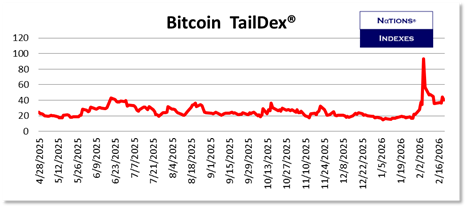
Bitcoin TailDex rose by 13.14% as traders recognize that extreme moves in Bitcoin remain likely.
You can learn more about TailDex at Learn More About TailDex.
Precious Metals:
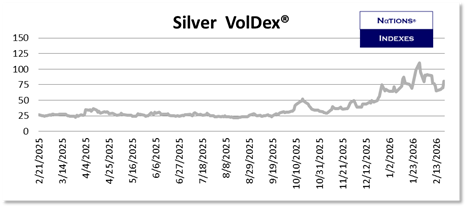
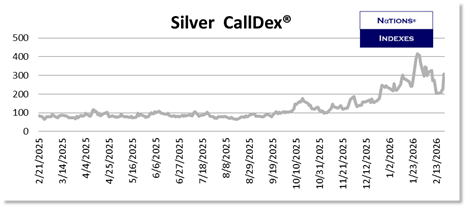
Silver gained 9.06% this week thanks to Friday’s rally of 7.19%.
Volatility was mixed in silver as you can see.
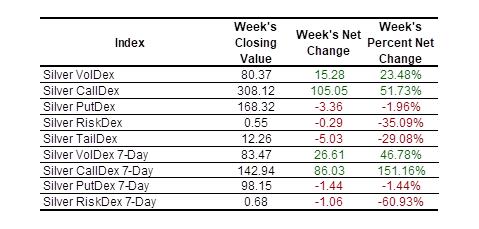
Silver volatility again assumed a very bullish “lean” with VolDex gaining 23.48% and CallDex gaining 51.73%.
Equities:
We have expanded the list of single names we cover to include not only the most dynamic stocks in the S&P 500 and the stocks with the highest option volume, but also the largest names in the S&P 500.
Technology and AI-related names pulled out of their funk with most names gaining ground. AAPL, GOOG, and NVDA all gained more than 3% for the week.
WMT fell despite good Q4 earnings because forward guidance was disappointing in relation to expectations.
In a complete reversal from last week, VolDex fell for every individual name we cover with the exception of GOOG (+1.86%). It fell by 10.45% in AAPL but that follows last week’s increase of 19.52%.
CallDex fell for nearly every name we cover in sympathy with the general lack of optimism. The decline in WMT CallDex is due to the passage of the earnings catalyst but the declines in CallDex for TSLA, META, PLTR, and AVGO are striking.
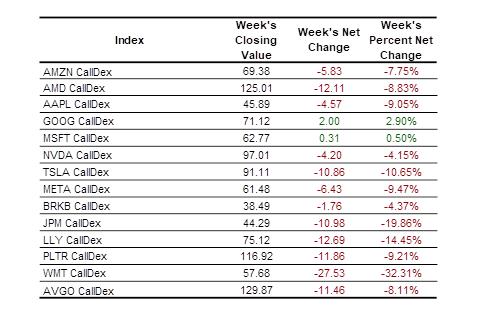
While general weakness in CallDex across indexes and individual equities means covered calls are not particularly attractive, it does mean that buying calls if you’re bullish, or using calls for stock replacement if you’re not, are strategies to be examined closely.
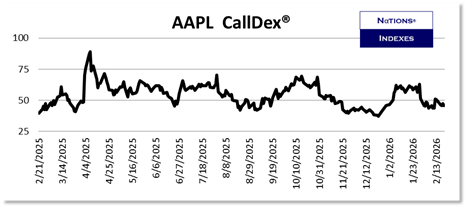
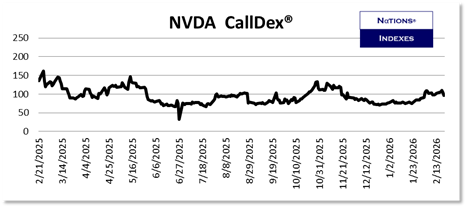
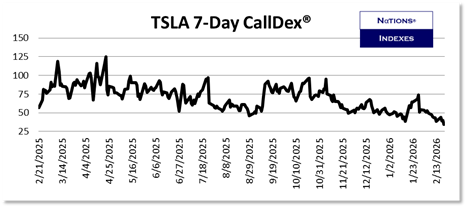
RiskDex was again green for most of the names we cover and it remains above 1.00, signaling put skew, for all of them. It even continues to increase in TSLA which has often had a RiskDex reading below 1.00 signaling call skew. We wonder if TSLA can maintain its current valuation (next 12-month PE of 200 and a market cap that is 3.3-times that of GM, F, STLA, and Toyota combined) if the market believes its prospects are similar to that for every other large automaker.
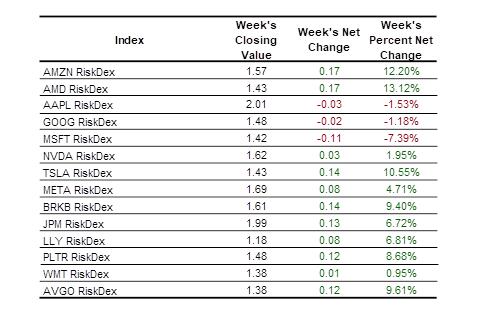
You can learn more about RiskDex here.
All our index values are available in real-time to subscribers.
We’ll continue to comment during the week via our X account, @Nations_Indexes.
Scott's Weekly Commentary:
The week worked out pretty well for investors in large part because of the expected but delayed Supreme Court decision that Trump can’t unilaterally impose tariffs. His immediate announcement that he’ll impose 10% global tariffs using a different mechanism was greeted with a big yawn by the market which clearly doesn’t believe he can manage it.
Bad news was good new as far as the equity market is concerned – this is not uncommon – in that weaker than expected growth in GDP fuels continued hopes that a reconstituted Federal Reserve, with a new Chair, will resume lowering rates. The PCE inflation data is pointing the other way but that’s not new. Hope (for rate cuts) springs eternal even if they’re not called for.
The rebound in AI-related names is good news and not that surprising; expect plenty of volatility in both directions in these names. That makes options good vehicles if you’re using the right structures. Short vol structures should define your risk so vertical spreads will be popular.
I think we’re seeing an important regime change in TSLA options. For a long time, TSLA has tended to show call skew (i.e., RiskDex below 1.00) meaning out-of-the-money calls were more expensive than out-of-the-money puts. This was an expression of the general adoration investors had/have for Elon and optimism for the company’s prospects. But as Jeff points out above, there are serious questions to be asked about TSLA’s market cap if it becomes more “similar” to the other carmakers. Should TSLA have a market cap that is more than 5-times that of Toyota? Yes, they make different cars but should it have a market cap that is 24-times that of Ferrari?
People have lost a lot of money betting against Elon but how does TSLA grow into that valuation if it moves toward a “lower-cost, higher-volume” strategy. Doesn’t that sound a lot like Toyota? And if TSLA is going to rely on autonomous driving then don’t they have to beat Waymo which has a huge lead?
I’m not betting against TSLA because I’m dubious, not dumb. But I’ll be watching.
Everyone at Nations Indexes hopes you have a healthy and profitable week.
Scott
