
It makes no sense but is completely logical and serves as a fantastic signal for traders. It is option skew, the tendency for different strike prices in the same expiry to display different, often very different, implied volatilities.
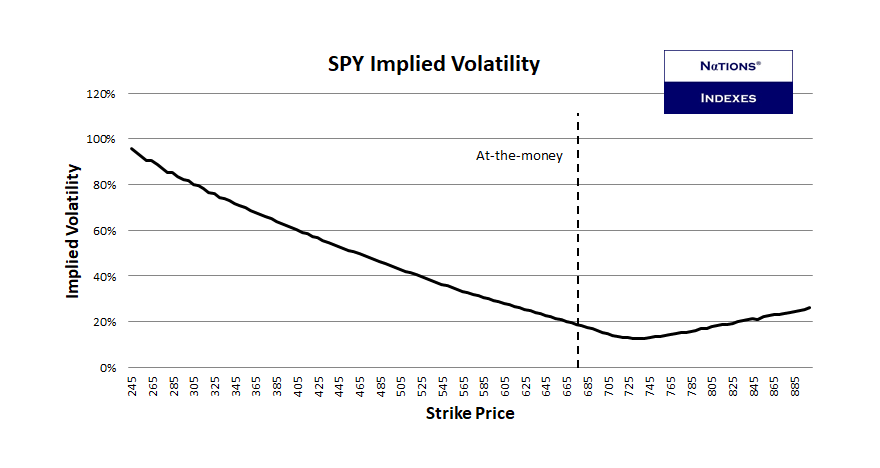
This is a chart of this morning’s implied volatility by strike price for SPY options in the March 20 expiration. You’ll note how implied volatility is different for each strike price.
An option’s implied volatility is the future volatility of the underlying that is implied by the option’s price. Option skew is the tendency for different strike prices in a single expiry to display different implied volatilities. Since the implied volatility applies to the underlying, skew makes no sense. The underlying will have only one path during the life of these options, only one realized volatility, so dozens of options displaying different implied volatilities is a little like asking each one the question, getting dozens of different answers, and saying they’re all correct.
But skew is completely logical because it addresses the fact that option pricing models don’t account for the real-world fact that markets tend to gap and jump and trade discontinuously. And which direction sees the biggest jumps and gaps for the S&P 500? Downward which is why puts are more expensive than calls.
Most importantly, skew can be a signal for traders. But how do we measure skew? I prefer using RiskDex, the ratio of PutDex (the normalized price of the 1 standard deviation out-of-the-money put option) to CallDex (the normalized price of the 1 standard deviation out-of-the-money call option).
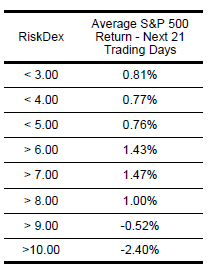
When RiskDex is high then puts are expensive relative to calls and there is much more fear than greed in the market. When RiskDex is low then puts are cheap relative to calls and there is little fear and plenty of greed.
You can learn more about RiskDex at Learn More About RiskDex.
But how can skew as expressed by RiskDex be a signal? The S&P 500 tends to behave in particular ways over the next 21 trading days (approximately 30 calendar days) when RiskDex is at an extreme as you can see below.
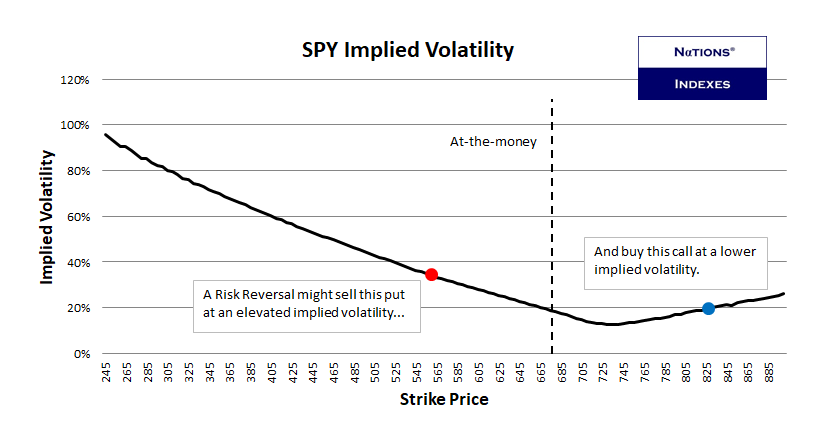
Skew can be a signal but it can also be a tool for option traders looking to take advantage of it. One great example is a “risk reversal” which generates long exposure by selling an out-of-the-money cash-secured put option and uses some of that premium to buy an out-of-the-money call option.
If you’ll pay attention to skew as a signal, and occasionally put it to work in your trading, your results are likely to improve.
All our index values are available in real-time at NationsIndexes.com where our goal is to make you a better trader by providing objective data so you don’t have to rely on a hunch or guess.
Follow us on X: @Nations_Indexes.
