
PutDex®
A VITAL MEASURE OF THE COST OF OUT-OF-THE-MONEY PUT OPTIONS.
The Nations® PutDex® Index measures the normalized cost of the 30-day to expiration put option that is 1 standard deviation out-of-the-money.
PutDex is the first and only measure of the cost of out-of-the-money put options. As such, it is a measure of expectations for a break in the price of the underlying stock or ETF as well as a general measure of expectations for volatility during the next 30 days.
Interpreting the Value of PutDex
The value of PutDex increases as the price of the 1 standard deviation out-of-the-money put option with 30 days to expiration increases. Higher put option prices indicate expectations for greater volatility during the next 30 days and a potential downside bias from speculators and traders. For traders who think in terms of deltas rather than standard deviation: 1 standard deviation out-of-the-money corresponds to a 16 delta.
So PutDex describes the normalized cost of out-of-the-money options prices. What do we mean by “normalized?” You can see below in the PutDex Construction section.
Since PutDex measures normalized option prices, any increase in option prices will increase PutDex. It is common for implied volatility, and hence option prices, to increase as the underlying market falls.
How Is PutDex Constructed?
The Nations PutDex Index measures the normalized cost of a hypothetical put option with precisely 30 days to expiration which is precisely 1 standard deviation out-of-the-money.
PutDex uses current option prices to calculate the 1 standard deviation threshold for the 2 expiration dates bracketing 30 days from today. It then interpolates a hypothetical option price with a time of expiration of precisely 30 days and a strike price precisely equal to this 1 standard deviation out-of-the-money threshold. This option price is then normalized by dividing by the forward price of the stock or ETF.
The best way to understand everything an option market has to say is to deconstruct skew and PutDex provides insight into this vital portion of the option market.
In summary:
-
- Uses option expirations which bracket the moment which is 30 days from now
- Calculates the point that is 1 standard deviation out-of-the-money, then uses the options around that point to calculate a theoretical option with a strike price precisely equal to the 1 standard deviation out-of-the-money threshold
- Normalizes the theoretical option price by dividing by the forward price of the underlying calculated using put/call parity.
Put Option Basics
A put option gives the owner of the option the right, but not the obligation, to sell the underlying asset at the exercise price, often called the strike price, before the option expires. The buyer of the put option pays a fee for this right; that fee is called the option premium.
Since the owner of the option has a right, but not an obligation, options are different from futures because both parties in a futures trade have obligations.
If the price of the underlying asset is below the strike price of the put option at the close of trading on the expiration date the owner of the put option will exercise their right and sell the asset at the strike price.
In exchange for the option premium received, the put option seller is obligated to buy the asset and and pay the strike price as payment if the owner chooses to exercise their option.
Buying a put option is generally a bearish strategy in that the price of the underlying needs to fall for the trade to be profitable. Every option one might buy, even an in-the-money option, will have some time value and the price of the underlying asset must fall enough to account for the time value paid.
Put options can also be bought by owners of the underlying asset as insurance or protection against the price of the asset falling below the strike price.
You can see the payoff profile for a long put option position here:
But before buying or selling a put option, we should have some gauge that can help us understand if a particular put option is historically expensive or cheap.
That’s where PutDex comes in. It provides a consistent, objective measure of the price of out-of-the-money put options that can be compared over time or across assets.
Historical Results
How To Use PutDex
While PutDex measures the cost of options at a specific point of the volatility curve, it can help traders and investors make more informed decisions, manage risk, and identify potential opportunities.
It is the focus that sets PutDex apart from volatility measures that amalgamate all options listed because if some measure like VIX is higher but PutDex is lower then that provides information other traders don’t have.
Key Ways to Use PutDex in Trading
Market Sentiment Gauge
PutDex provides insight into overall market sentiment. As you can see in the historical graph above, PutDex reacts to general changes in volatility; PutDex will rally when fear and uncertainty increase because traders will reach to buy options in order to “get long volatility” (they do so by buying put options and buying the underlying so that the position is “delta neutral).
PutDex provides insight that is different than that provided by CallDex because PutDex and CallDex measure option cost at very different points on the implied volatility skew and PutDex and CallDex often diverge meaning they move in different directions on a close-to-close basis. That is valuable information because it is a direct measure of the directional expectations (or fears) as expressed by the option market. In the S&P 500, PutDex and CallDex diverge on a close-to-close basis on 42.2% of all trading days.
Here you can see important metrics regarding the history of S&P PutDex although we calculate PutDex on a wide variety of assets and each will have its own, often very different history (subscribers can access this data, updated on a daily basis, here.
As a sentiment gauge, we would consider PutDex to be high when it’s above the 75th percentile. We would consider it to be very high when it is above the 90th percentile. If VolDex is also very high then sentiment is poor and the market is worried about direction. Traders are likely bidding up out-of-the-money put options in order to get long volatility and build downside protection.
We would consider PutDex to be low if it is below the 25th percentile value, and we would consider it to be very low if it is below its 10th percentile level.
When coupled with VolDex, PutDex can provide more nuanced insight into market sentiment. If VolDex is at an historically moderate level but PutDex is at a level that is relatively higher, that is a signal of negative sentiment and fears of a downward directional bias rather than fears of generalized volatility.

Lifetime and 52-week metrics are updated daily and those values are available to subscribers.
Timing Option Market Entries and Exits
Since PutDex measures the cost of specific options it can be used as a signal to buy out-of-the-money put options as a speculation or hedge or to sell cash-secured put options.
- Traders want to buy put options when they’re historically cheap and the prospects for a break in the stock are strong.
- Investors might want to buy protection put option positions when put options are cheap and the stock has rallied strongly.
- Investors want to sell cash-secured puts when puts are expensive and the stock is not vulnerable to a decline from highs. Selling cash-secured puts can be particularly profitable when PutDex is combined with a momentum indicator like RSI which indicates the underlying is oversold.
PUTDEX CAN HELP TRADERS AND INVESTORS DO ALL OF THIS MORE EFFECTIVELY
By combining PutDex with a simple moving average, many investors are making better decisions regarding their trading of put options which can be expensive to own.
For example, if put options as measured by PutDex are inexpensive and a stock is both above its 50-day moving average and technically overbought, that might be a good time to buy speculative put options or put option spreads.
On the other hand, if you would like to own the stock and put options as measured by PutDex are expensive and the stock is well below the 50-day moving average (or your preferred metric) then selling cash-secured puts is likely to be attractive.
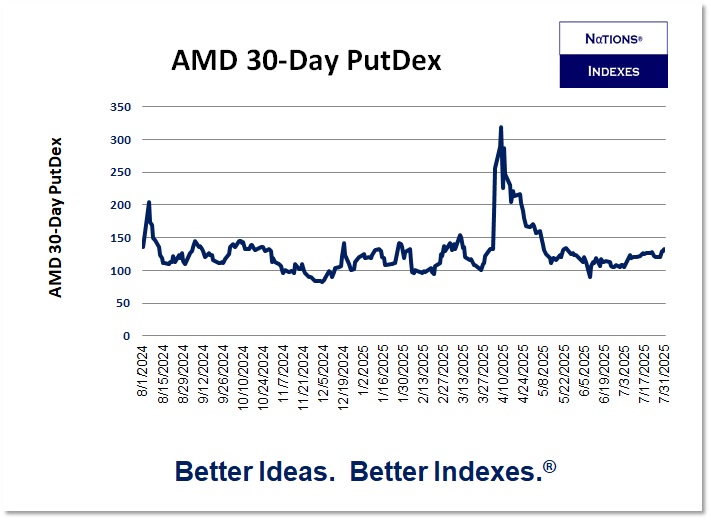
For example, take a look at a recent PutDex chart for high-flyer AMD. Some investors are probably wondering if AMD is overextended to the upside. At this point it had gained 85% in the previous 3 months and 27% in the previous 30 days. IT was 32% above the 52-day moving average and RSI was 83 so it was technically overbought. Would a long put position be profitable? You can see the 52-week history for AMD PutDex at this point as it was at the 21st percentile of its 52-week range.
It’s up to every trader to decide but PutDex gives you insight you didn’t have before.
Timing Underlying Market Entries and Exits
PutDex offer unique insight into the thinking of traders. Because of this it can help in timing underlying market entries and exits.
For example, in the S&P 500 (the underlying asset for all our S&P 500 indexes is SPY, the S&P 500 ETF), PutDex can help time market entry and exit and guide out-of-the-money put option strategies.
Get PutDex Data In A Subscription
If you’re looking for actionable volatility information about ETF’s, Individual Equities, or both, we’ve got a service for you.
