The Weekly Takeaway:
- The S&P 500 gained 0.88% this week. That is 8 straight weeks of gains. The index is now up 9.17% for the year;
- The Nasdaq-100 gained 1.22% this week. The index is now up 16.76% for the year;
- Crude oil futures fell 5.21% to close at 96.23;
- The yield on Treasury Notes retreated slightly, falling 3.7 basis point after last week’s increase of 23 basis points. It closed this week at 4.558%;
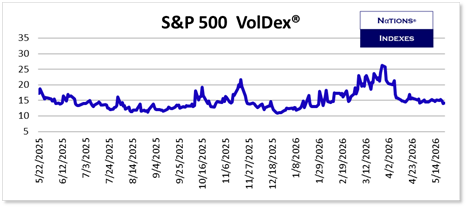
- S&P 500 VolDex (ticker VOLI) fell 7.16% to close at 14.14 but, oddly, it rose by 0.02 or 0.12% on Friday. That is odd because the S&P 500 was higher and we’re going into a 3-day weekend. We discuss below;
- Every S&P 500 volatility index fell with the exception of 30-Day CallDex which rose by 11.53% as optimism returned to equities. This is an impressive display of that optimism and we discuss below. You can learn more about CallDex at Learn More About CallDex;
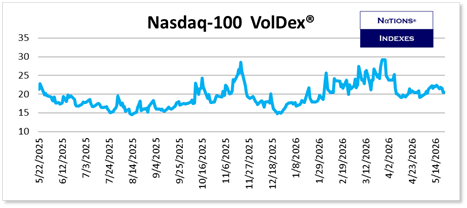
- VolDex on the Nasdaq-100 fell by 8.79% this week but was nearly unchanged on Friday (falling 0.01 to close at 20.46) despite the rally in the Nasdaq-100 and the looming 3-day weekend;
- Nasdaq-100 CallDex fell 2.38% but that is a correction of the 48.17% increase 2 weeks ago. This week’s close of 37.03 is the 79th percentile of its 52-week range and is still signaling substantial bullishness on the part of investors;
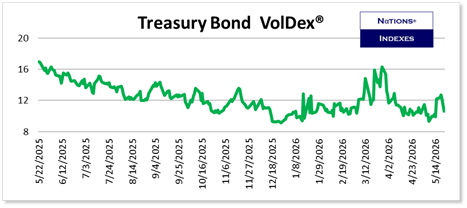
- Volatility in Treasury Bonds eased this week after spiking last week in the face of substantially lower bond prices. Treasury Bond VolDex fell 12.41% to close at 10.65. Traders should pay close attention to the 10.00 level as an opportunity to buy vol or to use long option positions for a directional thesis. This opportunity should not be missed;
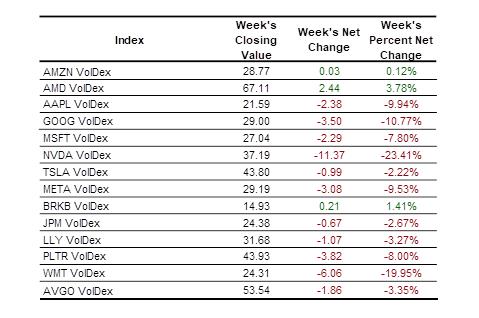
- The individual equities we cover were mixed this week with NVDA falling 4.43% after earnings. GOOG, MSFT, and AVGO also fell. AMD was again the big winner, gaining 10.24%;
- VolDex on individual stocks showed mostly red. NVDA VolDex fell 23.41% in the typical post earnings “vol crush”;
- You can always learn more about all our indexes at Learn More About Our Indexes.
Equity Index Volatility:
The S&P 500 gained 0.88% this week thanks to Wednesday’s gain of 1.08%. The index has gained for 8 straight weeks.
S&P 500 option prices eased, reversing the previous week’s concern. Only CallDex rose for the week as traders again bought upside calls to get bullish exposure.
S&P 500 VolDex closed on Friday at just the 21st percentile of its 52-week range despite the possibility of trouble in the Persian Gulf and the fact that crude oil prices are up 44.15% since the war started and inflation running hot. Friday’s small gain in VolDex seems to be an acknowledgement of these issues. It is common for volatility to fall in advance of holiday weekends so Friday’s price action is worth noting for upcoming holiday weekends like those for Juneteenth and Independence Day.
Regarding inflation, one month ago the market was signaling that any change in the Fed Funds rate before the end of the year was likely to be a rate cut (23.4% likelihood). Now it is saying any change is likely to be a rate hike (67.5% likelihood). That change is appropriate given recent inflation data but is a problem for equities as higher interest rates make stocks, particularly growth stocks, less attractive.
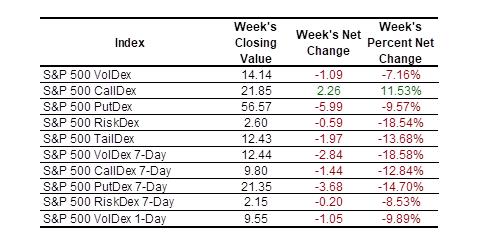
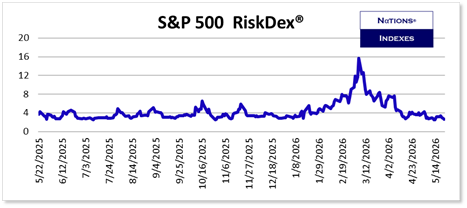
S&P 500 RiskDex fell by 18.54% for the week and closed at just 2.60, well below its long term (back to 2005) average of 3.78 and median over that period of 3.43. This week’s close was just the 1st percentile of its 52-week range. This signals clearly that investors have very little concern of an equity pullback over the next 30 days.
Historical metrics (Average, median, 10th percentile, 25th percentile, 75th percentile, and 90th percentile) for all our indexes are available to subscribers at NationsIndexes.com.
Why It Matters…Historical data for all our indexes is available to subscribers at the Everything! level and they allow option traders to understand the context of the current option pricing environment. You have to understand what normal is in order to do so.
Nasdaq-100 VolDex fell by 8.79% to close at 20.46. That is 40th percentile of its 52-week range (vs. 21st for the S&P and 33rd for the Russell 2000) in recognition of the fact that the Nasdaq-100 has been more volatile than those other indexes and is extended to the upside.
The relative strength index for the Nasdaq-100 was 71.09 as of Friday’s close indicating that the index is slightly overbought.
You can learn more about VolDex at Learn More About VolDex.
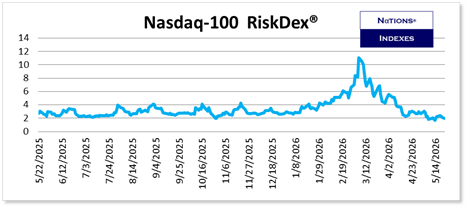
Despite the Nasdaq-100 being slightly overbought, Nasdaq-100 RiskDex closed on Friday at the extremely low level of 2.01 (vs. long-term average, back to 2014, of 3.17).
Why It Matters…Traders have to have the objective data provided by our indexes to trade in a way that doesn’t rely on hunches or guesses.
Option Window®:
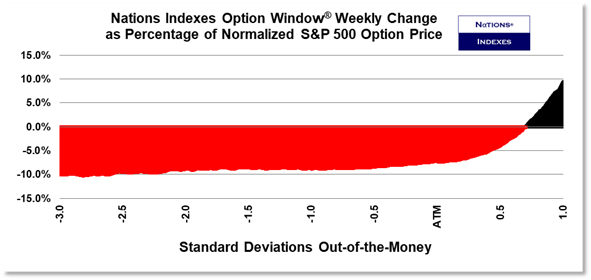
S&P 500 Option Window fills in the blanks between TailDex, PutDex, VolDex, and CallDex and reveals how trade flows were driving option prices. Since Option Window calculates normalized option prices at fixed points of moneyness any changes are driven by option flows rather than movement in the underlying S&P 500.
Option prices fell over the bulk of the S&P option skew but they fell evenly without traders picking on any particular area.
Term Structure:
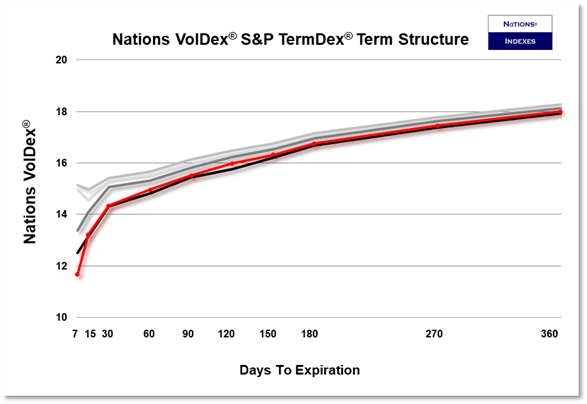
The Nations TermDex® measure of VolDex term structure illustrates S&P 500 VolDex for various tenors. It provides insight into both near-term and longer-term expectations for volatility in the S&P 500.
Term structure at the close on Friday (in red) remains sharply upward-sloping from left to right signaling very little concern for the near future.
1DTE Options:
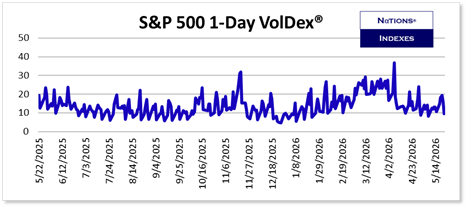
S&P 500 1-Day VolDex fell by 9.89%.
Very short-dated volatility measures which use a variance swap methodology, as 1-day VIX does, inject significant error into the resulting measure because of the way out-of-the-money options trade in the hours before expiration. The VolDex at-the-money methodology is particularly suited for these very short-dated tenors.
Other Asset Volatility:
Treasury Bonds and Notes:
Bond and Note yields gave back a small portion of last week’s gains. That allowed traders to sell vol.
Treasury Bond VolDex fell by 12.41% and is again nearing the 10.00 level. Traders should not miss the opportunity to buy at-the-money Treasury Bond volatility if VolDex is below 10.00. At that level any directional thesis should be expressed using long positions in at-the-money options.
Precious Metals:
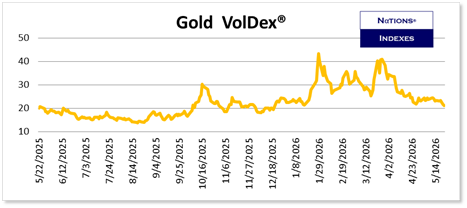
Gold fell 0.75% for the week and has lost ground 7 of the last 10 trading days. Gold VolDex fell 9.37% for the week and closed at 21.11.
Equities:
We have expanded the list of single names we cover to include not only the most dynamic stocks in the S&P 500 and the stocks with the highest option volume, but also the largest names in the S&P 500.
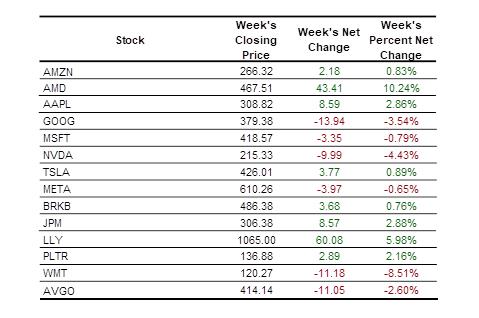
AMD was again the big winner, gaining 10.24% for the week. It is now up 118.30% YTD. AMD VolDex was one of the few gainers this week as traders bought at-the-money options to take advantage of expectations for renewed volatility in the chipmaker. We too often think that higher implied vol levels are an expression of fear – in this instance traders are bidding up volatility because volatility to the upside is volatility too.
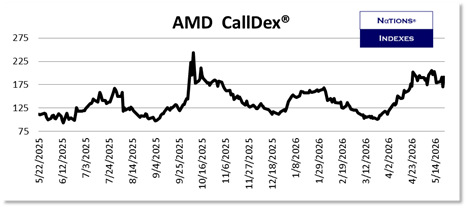
AMD volatility is higher across the entire skew with AMD CallDex at the 65th percentile of its 52-week range and AMD PutDex at the 60th percentile of that range.
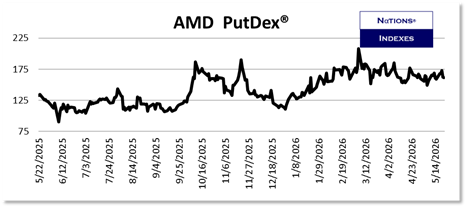
You can learn more about PutDex at Learn More About PutDex.
We’ll continue to comment during the week via our X account, @Nations_Indexes.
Scott’s Weekly Commentary:
The market has reversed its expectations for the next interest rate move by the Federal Reserve and rightly so. There will be enormous political pressure on the new Chair, Kevin Warsh, to cut interest rates but that would be precisely the wrong move in the face of resurgent inflation and the market trusts that he will be able to resist that pressure because an interest rate cut in this environment would be like hitting the afterburner for inflation. The other members of the Fed’s Open Market Committee will have a say as well.
We have been working with one of the well-known AI platforms and I am now convinced AI will be an enormous boost to productivity that will rival breakthroughs like the steam engine, railroads, electrification, computers, and the internet. We’re not close to being there yet and while it is doing some great things for us there is still a lot of activity that isn’t particularly productive. The vast majority of Americans will be helped by AI. Who will be hurt? Luddites who are early in their careers and refuse to embrace what it can do and mid-level coders. That whole swath of the coding workforce is going to be wiped out. I think most of the domestic coders will manage to transition to some other function in the space but offshore coders who were less expensive and took advantage of time shifting, are toast. That’s going to be a real blow to their own domestic economies.
So I’m bullish on AI in general, the companies that provide it, and those who embrace it. But I also think the stock market is getting ahead of itself. There’s not enough short-term skepticism and too much optimism. Five of the 10 largest names in the S&P are displaying call skew meaning RiskDex is below 1.00 (i.e., CallDex is higher than PutDex). At one point this week it was 6 of the 10. This has been a great contrarian indicator in the past.
I hope you have a safe and profitable week.
Scott