The Weekly Takeaway:
- The S&P 500 lost 2.59% this week due to a loss of 2.64% on Friday as better than expected job growth fueled worries about higher interest rates. The index is now up 7.86% for the year;
- The Nasdaq-100 lost 4.53% this week and lost 4.77% on Friday. The index is now up 14.68% for the year;
- The yield on Treasury Notes rose by 8.3 basis points this week to close at 4.536%. The increase was due to that better than expected jobs data with 172k new jobs created in May while the market expected 85k;
- Crude oil futures rose 2.96% this week to close at 90.38;
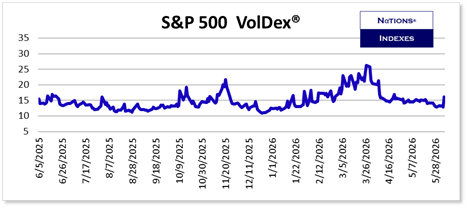
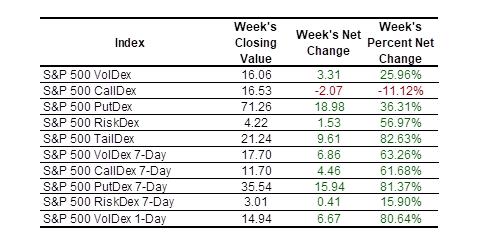
- S&P 500 VolDex (ticker VOLI) rose 25.96% to close at 16.06;
- Every S&P 500 volatility measure rose substantially with the exception of CallDex. CallDex fell as traders sold out-of-the-money calls to get short exposure to the S&P. Volatility metrics in the 7-Day tenor rose more than the 30-Day tenors;
- RiskDex rose 56.97% in the 30-Day tenor. You can learn more about RiskDex at Learn More About RiskDex;
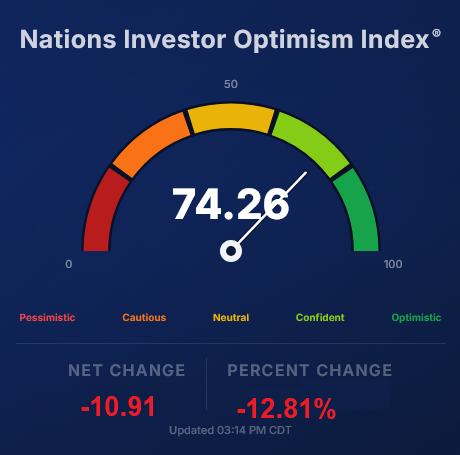
- The Optimism Index fell by 12.81% to close at 74.26;
- VolDex on the Nasdaq-100 rose by 27.11%;
- Nasdaq-100 7-Day PutDex rose by 37.39% this week after gaining 1.96% last week in a signal that traders were rightly cautious;
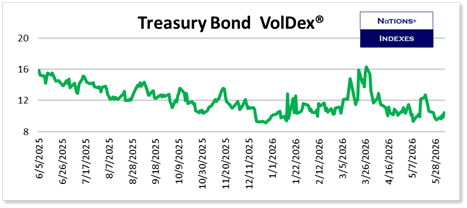
- Volatility in Treasury Bonds rose this week with Treasury Bond VolDex gaining 9.61% and closing at a still muted 10.41. Treasury Bond volatility gains were tempered by the volatility crush that is common in fixed income volatility following the release of the weekly jobs report;
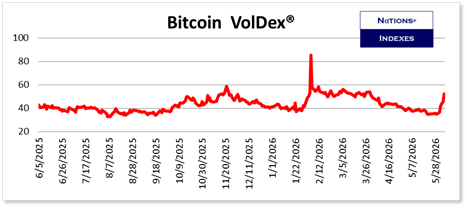
- Volatility in Bitcoin surged as the cryptocurrency lost 17.45% this week. It fell by at least 2.64% every day. Bitcoin VolDex rose 49.58% to close at 52.41. Bitcoin PutDex rose by 78.42%;
- The individual equities we cover were mostly lower this week with “old economy” names BRKB, JPM, LLY, and WMT the only gainers. TSLA, PLTR, and AVGO all most more than 10% for the week;
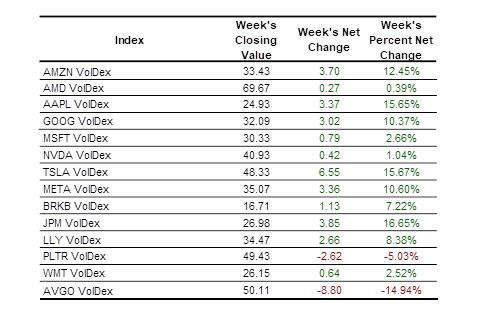
- VolDex on individual stocks generally gained as would be expected given the price action. It fell for AVGO because the company reported earnings on Wednesday;
- You can always learn more about all our indexes at Learn More About Our Indexes.
Equity Index Volatility:
The S&P 500 lost 2.59% for the week due to Friday’s loss, breaking a streak of 9 straight weekly gains.
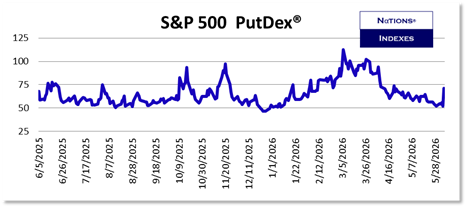
S&P 500 option prices spiked as you can see below. Last week we pointed out that “It is interesting that CallDex fell by more than PutDex” and that was certainly one of several signals index options gave last week that traders were dubious about the strength in the market.
S&P 500 VolDex closed on Friday at the 34th percentile of its 52-week range so volatility is elevated but not overly so. PutDex closed at the 37th percentile of its 52-week range.
Historical metrics (Average, median, 10th percentile, 25th percentile, 75th percentile, and 90th percentile) for all our indexes are available to subscribers at NationsIndexes.com.
Why It Matters…Historical data for all our indexes is available to subscribers at the Everything! level and they allow option traders to understand the context of the current option pricing environment. You have to understand what normal is in order to do so.
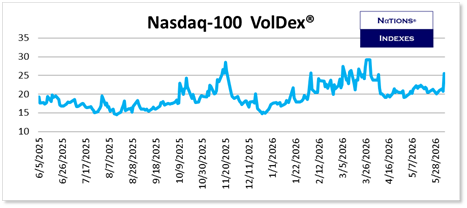
As mentioned above, Nasdaq-100 VolDex rose by 27.11% to close at 25.57. That is the 75th percentile of its 52-week range so worried traders are bidding up technology vol.
You can learn more about VolDex at Learn More About VolDex.
Last week we pointed out that Nasdaq-100 VolDex remained above 20 and “This is a signal that traders expect realized volatility in the Nasdaq-100 to remain elevated relative to that in the S&P 500 over the next 30 days” and “Nasdaq-100 7-Day PutDex rose by 1.96% this week in another signal that traders recognize the potential for significant volatility in the Nasdaq-100.”
That certainly proved prescient as high-flying AI names came back to earth this week.
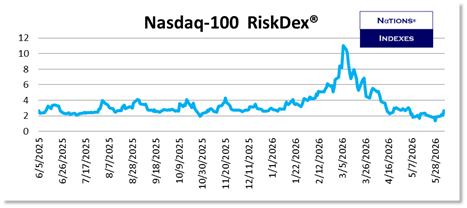
Last week we also pointed out that “Despite the Nasdaq-100 being overbought and getting more overbought versus the previous week, Nasdaq-100 RiskDex fell by 7.85% and closed below 2.00. It is at just the 5th percentile of its 52-week range. We believe call-spread collars are interesting trade structures in QQQ options.” That trade was very profitable.
This week saw a rally in Nasdaq-100 RiskDex but Friday’s close put it at just the 14th percentile of its 52-week range so it is still possible to put on hedges.
You can learn more about RiskDex at Learn More About RiskDex.
Why It Matters…Traders have to have the objective data provided by our indexes to trade in a way that doesn’t rely on hunches or guesses.
Investor Optimism Index®:
The Investor Optimism Index® fell by 12.81% to close at 74.26 which is still optimistic for equities over the next 30 days.
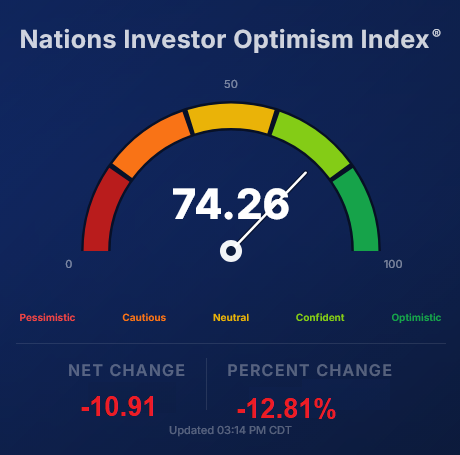
The index takes into account the current levels of S&P 500 VolDex, TailDex, and RiskDex and compares them to their rolling 2-year ranges. It is plotted on a 0 to 100 scale.
Our Optimism Index is now available in real-time on our home page at Nations Optimism Index.
Option Window®:
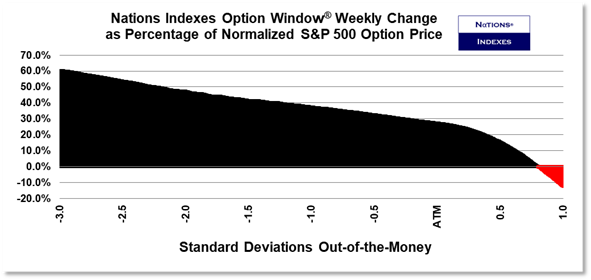
S&P 500 Option Window fills in the blanks between TailDex, PutDex, VolDex, and CallDex and reveals how trade flows were driving option prices. Since Option Window calculates normalized option prices at fixed points of moneyness any changes are driven by option flows rather than movement in the underlying S&P 500.
Option prices were higher across the bulk of the skew with only out-of-the-money calls falling on the week as traders sold them to get short exposure. Deep out-of-the-money puts were strongly bid.
Term Structure:
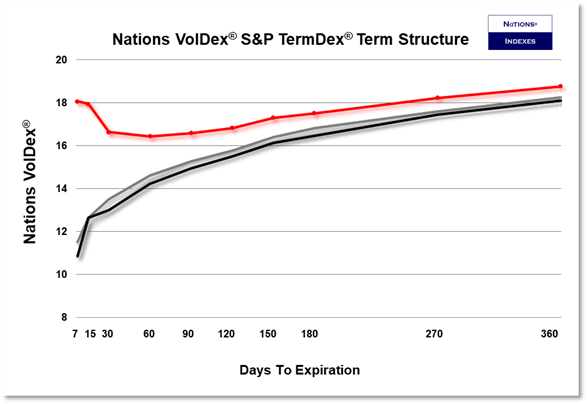
The Nations TermDex® measure of VolDex term structure illustrates S&P 500 VolDex for various tenors. It provides insight into both near-term and longer-term expectations for volatility in the S&P 500.
Term structure at the close on Friday (in red) rose across all tenors with short-dated expirations spiking considerably, signaling concern for the next 30 days.
1DTE Options:
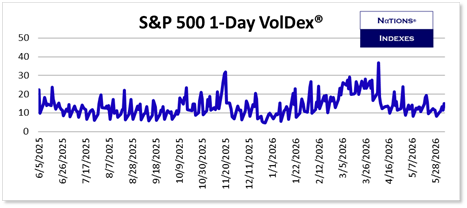
S&P 500 1-Day VolDex rose by 80.64% to close at 14.94.
Very short-dated volatility measures which use a variance swap methodology, as 1-day VIX does, inject significant error into the resulting measure because of the way out-of-the-money options trade in the hours before expiration. The VolDex at-the-money methodology is particularly suited for these very short-dated tenors.
Other Asset Volatility:
Treasury Bonds and Notes:
Bond and Note yields rose and volatility gained as well. However, Treasury Bond volatility is still reasonably priced and we remain convinced that directional trades in treasuries should use long volatility structures.
Precious Metals:
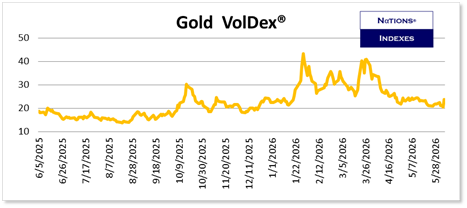
Gold fell by 3.69% on Friday and by 5.22% for the week as higher interest rates make gold less attractive.
Bitcoin:
Bitcoin got hammered this week, losing 17.45%. It briefly traded below $60k on Friday. Bitcoin VolDex gained nearly 50% this week and closed at 52.41. This has historically been a level that traders were willing to short. We will see if that pattern returns.
Equities:
We have expanded the list of single names we cover to include not only the most dynamic stocks in the S&P 500 and the stocks with the highest option volume, but also the largest names in the S&P 500.
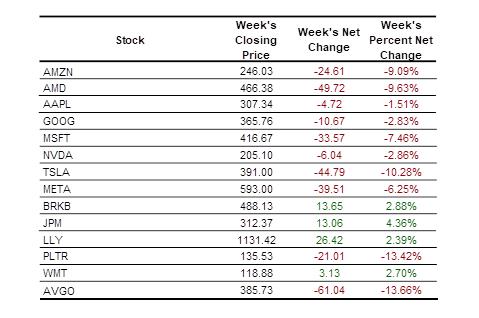
The AI related names that have done so well had a tough week with AMD falling 9.63%, PLTR losing 13.42%, and AVGO falling 13.66%. We have noted NVDA’s weakness since it reported earnings and it lost a modest 2.86% this week.
VolDex for these names was higher as traders brace for follow through next week.
Last week we mentioned that several names were overbought with RSI readings above 70. That was universally resolved this week and the closest name to overbought is LLY with an RSI of 68. None of the names we cover is yet oversold (i.e., RSI below 30) and AMZN and AVGO are the only names with RSI readings below 40.
Several names are sporting PutDex values that indicate reasonable prices are available for out-of-the-money puts. You can see PutDex charts for AAPL, TSLA, and AMZN below.
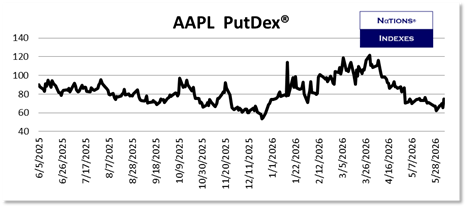
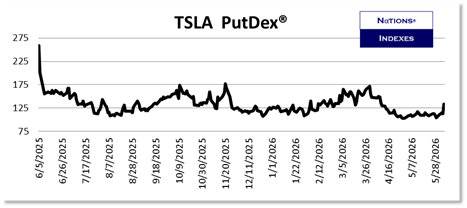
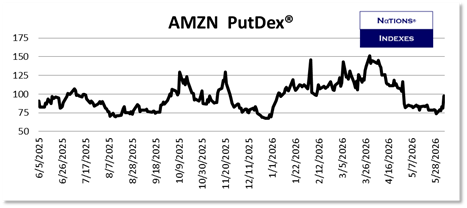
You can learn more about PutDex at Learn More About PutDex.
We’ll continue to comment during the week via our X account, @Nations_Indexes.
Scott’s Weekly Commentary:
One question I hear frequently during times like this wonders how the good news of better than expected job growth, like we learned about on Friday, can be bad news. I agree that it seems goofy on its face but if more people are making, and spending, more money, then inflation and interest rates will go up. Add $90 crude oil and $5 gasoline to the mix and the picture comes into sharp focus.
We also tend to forget, while growth stocks are surging, that higher interest rates now mean those future earnings are worth less.
A final musing about the massive, looming IPOs as SpaceX’s is expected to price and begin trading this coming Friday and Anthropic’s is likely to come soon: I bet they’re not going to be good for the rest of the market. They’re likely to pull money from other names, particularly at the valuations mentioned ($1.77 trillion for SPCX). But debuts like this are fun to watch.
I hope you have a safe and profitable week.
Scott