CallDex and Covered Calls
Do you remember the first option trade you made? It was likely selling a covered call and for good reason. A covered call takes advantage of the fact that options usually cost more than they’re ultimately worth and it also takes advantage of the erosion of an option’s price over time.
To recap, a covered call is an option strategy where an investor sells a call option on a stock or ETF they already own (we’re going to focus on out-of-the-money call options). Ownership of the stock “covers” the obligation to sell the stock if the call is exercised. The covered call seller collects the premium from the option buyer and that is the sellers to keep. (As an aside, don’t buy the underlying shares just so you can sell a covered call. If you want the same sort of payoff profile you’re better off selling a cash-secured put which we’ll discover soon.)
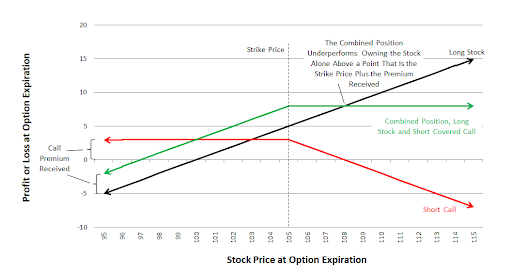
Below you can see the payoff profiles for stock you own from $100 a share (in black), a covered call with a strike price of $105 that you were able to sell at $3 (in red), and the combined position (in green).
But how can you find good candidates for covered calls? We’re here to help.
First, any stock or ETF in your portfolio is a candidate. Remember that if your stock is called away you may realize a gain that would be taxed.
But beyond that, how do we find good candidates for covered calls?
We would suggest focusing on two bits of information: how expensive are the calls relative to calls on the other stocks and ETFs you own and, second, how expensive are those calls relative to how expensive they have been in the past.
The first, how expensive are the calls relative to calls on other stocks and ETFs is important but can be misleading. Some calls are just not very expensive because the underlying stock isn’t very volatile.
For example, MSFT stock isn’t very volatile so MSFT options tend to be pretty cheap. TSLA stock is very volatile so TSLA options tend to be pretty expensive.
This doesn’t mean MSFT isn’t a good candidate for a covered call which is why we say it can be misleading.
It also doesn’t mean TSLA is a great candidate for a covered call. Why?
Because of the second bit of information we want to focus on: how expensive are those calls relative to how expensive they’ve been in the past. This is where CallDex is invaluable.
CallDex provides the normalized price of a call option that is 1 standard deviation out-of-the-money with 30 days to expiration. For those of you who think in deltas rather than standard deviations…1 standard deviation out-of-the-money corresponds to a 16 delta.
We would focus on stocks and ETFs which have a CallDex value which is in the top half of the 52-week range.
That’s now CallDex can help; it turns a hunch or intuition about the cost of call options into objective data.
If the trend for the stock is also higher then we have a great candidate for a covered call. Why should a stock be trending higher?
Because it’s possible for a stock to be near the bottom of its recent range and for fear from that to be driving option prices higher.
We don’t want to sell a covered call on a stock that’s already in the hole because we’re not going to like the effective price if it gets called away.
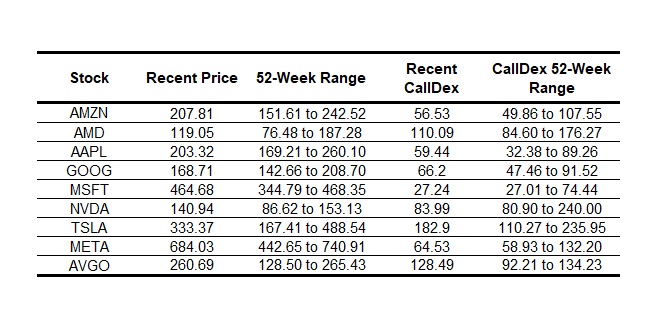
Let’s look at some of the stocks we cover to unearth any worth covered call candidates. This isn’t a full list of the stocks we cover but this should allow us to get started.
Let’s look at these alternatives.
The stock of AMZN, MSFT, NVDA, TSLA, META, and AVGO are in the top half of their 52-week range. MSFT and AVGO are very near the top of their recent ranges.
Looking at CallDex, only TSLA and AVGO are in the top half of their recent ranges. AVGO stock price is near the top of its recent range and AVGO CallDex is near the top of its recent range. That makes AVGO a great candidate for a covered call.
Let’s take it one step further. As of June 4, 2025, the call strike price in the July 3 expiry with approximately a 16 delta is the $300 strike (actually an 18 delta). An investor could sell that covered call at $3.35.
Since each option corresponds to 100 shares that would result in our investor receiving $335 for each option sold. That money is theirs to keep no matter what (this is not a trade recommendation but an illustration of the sort of exercise an investor might undertake).
And what happens if AVGO keeps rallying? If it is above $300 per share at the July 3 expiration then it’s going to be called away but at an effective price of $303.35. That’s not too bad for a stock that’s currently at $260.69.
There you have it. That’s how CallDex can help you identify better covered call candidates. This will make you a better trader and help you make more money.